
PPC Agency Near Me: Smarter Paid Search Decisions for Telehealth Providers
For telehealth clinics, virtual care platforms, allied health providers, and hybrid medical practices, a search for ppc agency near me is rarely just about finding someone to run ads. It is usually about finding a partner who can help attract the right patients, promote appropriate services, manage advertising spend responsibly, and connect online campaigns to meaningful actions such as appointment requests, phone calls, intake forms, or virtual consultation bookings.
Paid search can be especially useful in healthcare because many people search when they have a specific need, question, or care pathway in mind. A helpful overview of what to evaluate when searching for a PPC agency near me explains that good PPC management should go beyond launching ads and should include tracking, search intent, landing pages, and reporting that supports clearer decisions.
For telehealth organizations, that same principle matters even more. Ads should not simply generate clicks. They should guide the right people toward the right care-related action while respecting platform policies, privacy expectations, and the need for accurate service messaging. Zigma Internet Marketing’s Google Ads (PPC) service focuses on the working parts behind paid search, including account structure, search terms, conversion tracking, landing pages, and measurable outcomes.
Quick Facts: PPC Agency Near Me for Telehealth
The short version for healthcare and virtual care marketing teams.
- What: PPC management includes paid search strategy, keyword targeting, ad copy, bidding, landing page alignment, and conversion tracking.
- Who: Telehealth providers should look for PPC support that understands search behaviour, analytics, conversion quality, and sensitive service messaging.
- Where: Paid search can support local, regional, or service-specific visibility for virtual care, hybrid clinics, and appointment-based healthcare services.
- How: Strong campaigns use verified tracking, search term reviews, negative keywords, landing page improvements, and reports that explain decisions.
- Why: Better PPC management helps reduce wasted spend, improve enquiry quality, and connect marketing activity to patient acquisition goals.
Why telehealth providers search for a ppc agency near me
Telehealth marketing has a different set of challenges than many other industries. People searching for care may be comparing services, looking for urgent information, checking whether virtual appointments are available, or trying to understand whether a provider is the right fit. A PPC agency should understand that not every click is equally valuable, and not every form submission represents a qualified patient enquiry.
A capable PPC agency manages more than keywords and bids. It works with the full campaign system: account setup, campaign architecture, location settings, keyword intent, match types, ad copy, landing page experience, conversion actions, budget pacing, and reporting. For telehealth providers, those details affect whether ads reach people who are actually looking for the services being offered.
The difference between traffic and useful demand matters. Clicks show that ads are attracting attention. Conversions show that a tracked action happened. Qualified appointments, appropriate enquiries, and booked consultations show whether the campaign is supporting the care model. Zigma’s broader Digital Marketing Services can connect paid search with SEO, website improvements, content, analytics, and reporting when a telehealth campaign needs more than ad edits.
What a PPC agency should manage for virtual care campaigns
A telehealth PPC account should be structured around real service intent. Campaigns may need to separate general awareness searches from high-intent appointment searches, branded searches, location-based queries, and service-specific terms. Without that separation, reports can look positive while hiding wasted spend or weak enquiry quality.
The agency should also understand the path after the click. A patient or prospective patient may need reassurance, clear eligibility information, simple appointment options, and a mobile-friendly intake process. If the landing page is confusing, slow, or too broad, even accurate ad targeting can fail to produce useful results.
Core areas a PPC agency should be able to explain
- Campaign structure: How services, locations, branded searches, and non-branded searches are separated.
- Keyword intent: Which searches indicate appointment intent, research intent, comparison intent, or poor fit.
- Negative keywords: Which irrelevant searches are being blocked to reduce waste.
- Conversion tracking: Which calls, forms, booking actions, or intake steps are being counted.
- Landing page alignment: Whether the page matches the ad promise and helps visitors take the next step.
- Reporting: Whether reports explain decisions rather than only listing clicks and spend.
How to evaluate a ppc agency near me for telehealth advertising
Choosing a PPC agency should not be based only on who sounds confident during a sales call. For telehealth organizations, the right partner should ask about services offered, patient intake process, booking flow, service areas, eligibility criteria, call handling, follow-up process, and what a qualified enquiry actually looks like.
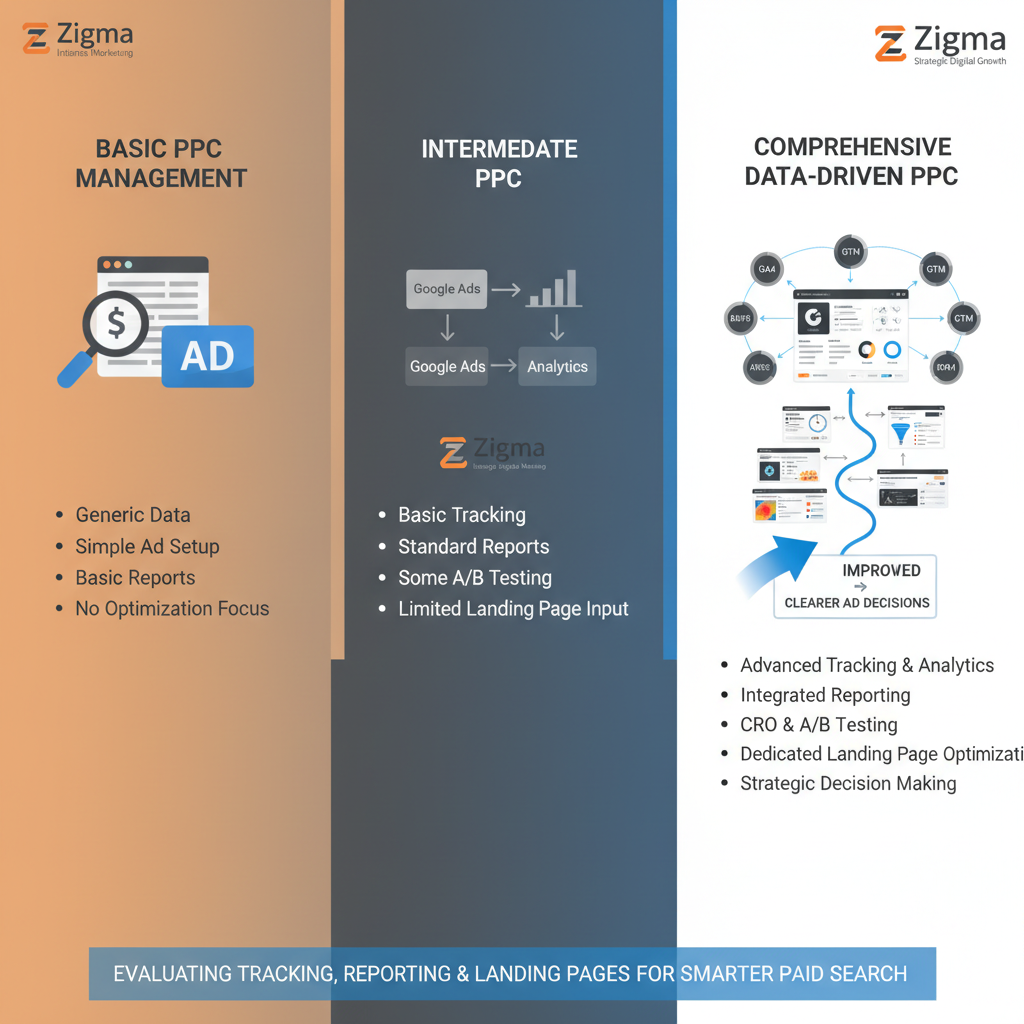
Use the comparison areas below to separate basic campaign management from the kind of paid search support that can improve decision-making.
Account review depth
A) Basic performance review: The agency checks spend, clicks, impressions, and conversions. This may identify obvious issues, but it does not always reveal whether enquiries are appropriate for the telehealth service.
- How it works: The review focuses on top-line platform metrics.
- Best fit: Useful as a quick starting point before a deeper audit.
- Example: An account may show conversions while some actions are low-value form fills or accidental clicks.
B) Search term and conversion review: The agency examines the actual queries that triggered ads and checks whether tracked conversions represent useful patient acquisition actions.
- How it works: The review looks at search terms, match types, negative keywords, conversion events, and campaign segmentation.
- Best fit: Useful when traffic is coming in but appointment quality is inconsistent.
- Example: A campaign may need negative keywords if ads are appearing for education-only searches instead of service-intent searches.
C) Full funnel review: The agency connects search activity to landing pages, analytics, intake forms, call outcomes, and booking data where available.
- How it works: The review follows the path from query to click, landing page visit, conversion action, enquiry quality, and appointment outcome.
- Best fit: Useful for telehealth providers where lead quality matters more than raw volume.
- Example: A form submission may look successful in Google Ads but still be a poor fit after intake review.
Reporting quality
A) Platform screenshots: Screenshots show activity but may not explain what changed or why results moved.
- How it works: Reports show standard Google Ads totals such as spend, clicks, impressions, and conversions.
- Best fit: Helpful for basic visibility but limited for management decisions.
- Example: A lower cost per click may look positive while enquiry quality declines.
B) KPI dashboard: A dashboard organizes metrics around the questions the organization needs answered.
- How it works: It may group cost per lead, conversion rate, search impression share, click-through rate, and landing page performance.
- Best fit: Useful for clinic owners, practice managers, and marketing teams who need monthly clarity.
- Example: A dashboard can help distinguish stronger targeting from weaker lead qualification.
C) Decision-focused reporting: A decision report explains what changed, what was learned, and what should happen next.
- How it works: The agency documents tests, risks, findings, and next actions.
- Best fit: Useful when leadership needs practical accountability rather than raw data exports.
- Example: A report may recommend shifting budget away from broad informational searches and toward service-specific appointment intent.
Landing page support
A) Ads-only management: The agency changes campaigns but does not improve the page after the click.
- How it works: Work is limited to bids, keywords, ad copy, and budgets.
- Best fit: May work when landing pages already load quickly, explain the service clearly, and convert well.
- Example: A strong appointment page may only need campaign refinements.
B) Page recommendations: The agency identifies landing page issues but depends on your internal team to implement changes.
- How it works: Recommendations may cover page speed, headline clarity, form length, mobile layout, trust elements, and calls to action.
- Best fit: Useful for organizations with internal web or marketing support.
- Example: A mobile form may need simplification if visitors abandon the page before submitting.
C) Campaign and page improvement together: The agency treats ads and landing pages as one system.
- How it works: Search intent, ad messaging, page copy, forms, calls to action, and tracking are reviewed together.
- Best fit: Useful when clicks are arriving but appointment requests or qualified enquiries are not keeping pace.
- Example: A landing page may perform better when its headline mirrors the specific virtual care service promoted in the ad.
Paid search signals that matter in telehealth
PPC reports can become technical quickly, but the useful questions are practical. Are the right people seeing the ads? Are they clicking because the message matches their need? Are they taking an appropriate next step? Are those actions turning into real appointments, intake conversations, or qualified enquiries?
Cost per click is not enough to judge performance. A low-cost click can still waste budget if the person is not looking for the service offered. A higher-cost click may be more acceptable if the search has strong appointment intent and the landing page helps the visitor act. The better comparison is not cheap traffic versus expensive traffic; it is weak intent versus useful intent.
- Click-through rate: Shows whether the ad appears relevant to the people seeing it.
- Conversion rate: Shows how often visitors complete a tracked action after arriving on the page.
- Cost per lead: Shows the ad spend required for each recorded enquiry, although quality still needs review.
- Search impression share: Shows how often ads appear compared with eligible search opportunities.
- Appointment or intake feedback: Helps connect platform data to real-world patient acquisition outcomes.
Common PPC mistakes in telehealth campaigns
Many paid search problems are quiet. They build through broad targeting, weak negative keyword lists, duplicate conversion events, unclear landing pages, mismatched service messaging, poor location settings, or automated bidding that is trained on unreliable conversion data.
The most important mistake is trusting platform totals without checking what they represent. A campaign can appear to be generating conversions while counting actions that do not reflect genuine patient interest. Before increasing spend, conversion tracking should be reviewed carefully.
Step 1: Audit conversion tracking before scaling spend
Check whether appointment requests, calls, forms, booking actions, or intake steps are being counted correctly. This helps avoid making decisions based on inflated or incomplete data.
Tracking detail: Review GA4 events, Google Ads conversions, form tracking, call tracking, and duplicate tags.
Business consequence: Incorrect tracking can make a weak campaign appear stronger than it is.
Step 2: Review search terms, not only keywords
Keywords are what the advertiser targets. Search terms are what people actually type. Reviewing search terms reveals whether ads are appearing for useful queries or irrelevant searches.
Tracking detail: Review queries by campaign, ad group, spend, and conversion action.
Business consequence: Poor search terms can drain budget while still generating clicks.
Step 3: Match landing pages to the care-related search intent
The page after the click should continue the same message the person saw in the ad. If the ad promotes a specific virtual care service, the landing page should make that service easy to understand and act on.
Tracking detail: Compare ad headlines, page headlines, appointment buttons, form placement, mobile layout, and page speed.
Business consequence: A mismatch can reduce conversion rate even when targeting is accurate.
Step 4: Separate branded, non-branded, and service-specific campaigns
Different campaign types behave differently. Branded searches often perform differently from non-branded service searches, and both should be evaluated separately.
Tracking detail: Segment reports by query type, campaign intent, and conversion source.
Business consequence: Brand traffic can make the rest of the account look stronger than it is.
Step 5: Review enquiry quality with the intake or operations team
Ad platforms count conversions, but internal teams often know whether those enquiries were appropriate. Campaign optimization should reflect real feedback where available.
Tracking detail: Compare form details, call notes, appointment status, and intake outcomes.
Business consequence: Campaigns can optimize toward volume while staff manage poor-fit enquiries.
How PPC, SEO, and telehealth landing pages work together
Paid search can help telehealth providers appear for timely, high-intent searches. Organic search can support longer-term visibility for educational topics, service pages, and recurring patient questions. These channels should not be managed in isolation. PPC data can reveal which queries lead to meaningful actions, while SEO can help reduce dependence on paid clicks for topics that deserve durable visibility.
For some virtual care providers, PPC is useful for testing service demand or promoting specific appointment categories. For others, PPC works best alongside SEO Services that support long-term search visibility. The website also plays a major role, especially when ad traffic lands on pages that need clearer explanations, stronger calls to action, or easier booking paths.
Zigma also supports Website Design & Development because PPC performance often depends on what happens after the click. A well-built landing page can clarify the service, reduce friction, support mobile visitors, and make tracking easier to interpret.
Questions telehealth teams should ask before choosing a PPC partner
Before hiring an agency, ask questions that reveal how the team thinks. The strongest answers should be specific, process-based, and connected to your service model.
- How will conversion tracking be checked before campaign changes begin? This shows whether the agency verifies data before trusting it.
- How will search intent be separated across campaigns? This reveals whether the agency understands the difference between research searches and appointment-intent searches.
- How often will search terms and negative keywords be reviewed? This shows whether waste reduction is part of routine management.
- Which metrics will appear in reports, and what decisions will they support? This separates reporting for visibility from reporting for action.
- How will landing page issues be handled? This clarifies whether the agency can address the post-click experience.
- How will appointment or intake feedback shape campaign changes? This shows whether the agency can connect ad data to operational reality.
Trust signals when searching for a ppc agency near me
Trust in PPC should be based on visible working practices. Look for clear reporting, careful tracking setup, ownership of campaign structure, and the ability to explain trade-offs without overpromising. Platform familiarity is useful, but it should be paired with practical account management and communication that helps your team make better decisions.
For telehealth providers, the right PPC partner should also understand that patient acquisition is not only about volume. Campaigns should be evaluated by the quality of enquiries, the clarity of the landing page, the accuracy of tracked actions, and the ability to improve decisions over time.
Zigma Internet Marketing supports paid search with implementation across tracking, analytics, landing pages, CRO, SEO, and reporting. If your organization wants a second opinion on PPC account structure, conversion tracking, or paid search strategy, you can reach the team at (647) 556-6071 or info@zigma.ca.
Get clarity before increasing telehealth ad spend
A careful PPC review should explain tracking accuracy, search intent, landing page gaps, and the next practical tests.
FAQs About PPC Agencies for Telehealth
Why would a telehealth provider search for a ppc agency near me?
A telehealth provider may search for a local or accessible PPC agency to get help with Google Ads strategy, conversion tracking, landing pages, reporting, and campaigns designed around appointment or enquiry quality.
How do I know if a PPC agency is being transparent?
A transparent agency explains what changed, why it changed, and how the change affected search terms, conversions, cost per lead, and enquiry quality. Reports should support decisions, not only display platform screenshots.
Should telehealth PPC campaigns use dedicated landing pages?
Dedicated landing pages are often helpful because they can match the exact service promoted in the ad, reduce confusion, and make booking or enquiry actions easier to track.
What should be checked before increasing Google Ads spend?
Before increasing spend, review conversion tracking, search term quality, negative keywords, campaign segmentation, landing page performance, and enquiry quality. Scaling a poorly tracked account can increase waste.
Can PPC and SEO support telehealth growth together?
Yes. PPC can reveal which queries lead to useful actions, while SEO can build longer-term visibility for service pages and educational topics. Shared reporting helps both channels focus on terms and pages that matter.
Related Topics
