
Digital Marketing Business Basics for Accountable Telehealth Growth
Telehealth marketing needs measurement, not just visibility
A digital marketing business serving telehealth organizations has a different responsibility than simply increasing clicks, followers, or website traffic. Virtual care providers, digital health platforms, remote patient monitoring companies, and hybrid clinics need marketing that connects patient or client demand to measurable actions such as booked appointments, intake form submissions, provider enquiries, demo requests, referral conversations, and repeat engagement.
The broader principles behind digital marketing business basics for accountable growth apply strongly in telehealth because every campaign should be judged by useful outcomes, not surface activity. For telehealth brands, that means understanding which channels create qualified demand while also respecting privacy expectations, accessibility needs, clinical messaging boundaries, and the trust required for healthcare decisions.
Telehealth audiences often compare options carefully before taking action. A patient may want reassurance about appointment availability, insurance or payment process, clinical fit, technology requirements, and what happens after submitting a form. A referring partner may need proof that the service is credible, easy to access, and appropriate for a specific patient group. Marketing must therefore support education, conversion, and confidence at the same time.
When telehealth marketing is managed as one connected system, strategy, search visibility, paid media, website experience, content, and reporting work together. For organizations comparing support across SEO, PPC, web design, content, social media, and analytics, Zigma Internet Marketing outlines its service areas through Digital Marketing Services.
Quick facts for telehealth marketing planning
Use this snapshot before increasing spend or comparing digital marketing vendors.
- Core purpose: Digital marketing turns search demand, paid traffic, content, and website visits into measurable telehealth enquiries, bookings, consultations, or partner conversations.
- Main channels: SEO, Google Ads, landing pages, educational content, email, social media, and analytics usually work best as a coordinated system.
- Key metrics: Useful reporting focuses on qualified appointments, intake completions, conversion rate, cost per lead, lead quality, and channel efficiency.
- Common risk: Campaigns can look successful through impressions and clicks while failing to produce patients, partners, or sales opportunities that match the service.
- Practical sequence: Fix tracking first, improve telehealth landing pages next, then scale the channels that produce qualified demand.
How a digital marketing business supports accountable telehealth growth
A digital marketing business creates accountable growth by aligning audience research, channel strategy, campaign execution, conversion tracking, and reporting. In telehealth, this alignment matters because people are not only buying a product; they are often deciding whether to trust a remote care model, book a clinical service, or share sensitive information online.
The first step is defining the conversion. For a telehealth provider, a conversion may be an appointment request, completed intake form, phone call, secure message, provider referral, webinar registration, app signup, or demo request from a healthcare organization. Once the action is defined, the marketing team can ask more useful questions: Which channel produced the enquiry? Which landing page helped the visitor act? Which search query or ad group created a qualified conversation?
This measurement discipline changes how marketing decisions are made. Instead of debating opinions about design, copy, or ad budgets, teams can compare behaviour in analytics, call records, form submissions, and customer relationship management data where appropriate. The goal is not to chase every available channel. The goal is to identify the few activities that produce meaningful demand and improve them over time.
Search engine optimization is often a strong foundation for telehealth because many patients and partners begin with search. They may look for virtual therapy, online urgent care, remote monitoring, chronic care support, telemedicine software, or answers to condition-specific questions. If SEO is a priority, SEO Services can help clarify how technical audits, content planning, and page improvements fit together.
The core channels for telehealth marketing
Digital marketing channels are not interchangeable. Each channel has a different role, timeline, and risk profile. The right mix depends on the telehealth service, audience type, geographic coverage, appointment model, sales cycle, website condition, and internal follow-up process.
SEO helps telehealth organizations meet existing demand
SEO helps telehealth websites appear for search queries connected to services, symptoms, care categories, software solutions, and comparison research. Technical SEO improves crawlability, site structure, and performance. Content SEO gives searchers clear answers before they book, subscribe, refer, or request a consultation.
For healthcare-related content, clarity is especially important. Pages should explain who the service is for, what it does and does not provide, how the appointment or onboarding process works, and what the next step looks like. SEO content should avoid overpromising and should be reviewed with appropriate clinical or compliance input when needed.
PPC can test high-intent telehealth demand faster
Pay-per-click advertising can place a telehealth service in front of people actively searching for help or solutions. The trade-off is direct spend. Weak keyword targeting, vague ads, poor negative keyword management, or a landing page that does not answer key questions can waste budget quickly.
Strong PPC management combines query control, ad testing, conversion tracking, and landing page alignment. For search campaigns, Google Ads Management provides structure for bidding, testing, optimization, and reporting.
Web design affects trust, accessibility, and conversion
A telehealth website often becomes the first trust checkpoint. Visitors need to understand the service quickly, navigate easily on mobile, find appointment or contact options, and feel confident that the organization is legitimate. Speed, mobile layout, accessibility, page structure, calls to action, and technical health influence both search visibility and paid campaign efficiency.
A redesign should not be treated as a visual project only. It should protect SEO value, improve conversion paths, simplify tracking, and support the practical needs of patients, providers, caregivers, or healthcare buyers. Website Design & Development should include technical, content, and conversion planning early.
Content and social media support confidence before action
Telehealth content should reduce uncertainty. Service pages, FAQs, educational articles, provider pages, onboarding guides, and social posts can explain how remote care works and what users should expect. Social media can support awareness and credibility, but it should be judged by its role in the decision journey rather than by engagement alone.
Why tracking should be fixed before telehealth campaigns scale
Marketing without reliable tracking creates noisy decisions. A campaign may appear successful because traffic is rising, while qualified appointment requests remain flat. Another campaign may look weak in platform data but generate phone calls or form submissions that are not being recorded correctly.
Useful tracking may include analytics setup, event tracking, form tracking, phone call tracking where appropriate, campaign naming standards, landing page reporting, and dashboard views that separate activity from business value. Sessions, impressions, and clicks are helpful diagnostic signals, but they should not be treated as success by themselves.
A practical telehealth reporting dashboard should help answer questions such as:
- Which channels create qualified enquiries? Lead source reporting helps identify where budget and effort deserve more attention.
- Which pages help people take action? Landing page data shows whether messaging, page layout, and calls to action support bookings or enquiries.
- Which campaigns waste spend? Search term reviews, audience data, and conversion records reveal mismatches between traffic and service fit.
- Which fixes should happen next? Reporting should guide decisions, not only display charts.
Tracking does not need to be overly complex at the start. A clean, trusted foundation is better than a complicated dashboard that nobody uses.
SEO and PPC are stronger when telehealth teams share data
SEO and PPC are often managed separately, but they can inform each other. Paid search can reveal which telehealth queries and messages create enquiries before an organization invests months in organic content. SEO data can show which topics attract steady demand and reduce dependence on paid clicks over time.
SEO versus PPC for telehealth growth
A) SEO for durable search visibility: SEO works well when a telehealth organization wants to build presence across service pages, educational content, provider information, and technical site health.
- How it works: SEO improves relevance, crawlability, internal linking, content depth, and authority signals so search engines and users can understand the site more clearly.
- Best fit: SEO fits services with recurring search demand, stable offerings, and a need for long-term visibility.
- Example: A virtual care provider may build pages for core services and publish answer-focused content that supports those pages.
B) PPC for controlled testing: PPC works well when a telehealth organization needs faster feedback on messages, keywords, and landing page performance.
- How it works: Paid campaigns target search queries or audiences, then use conversion data to refine bids, ads, exclusions, and landing pages.
- Best fit: PPC fits new service launches, seasonal campaigns, competitive service categories, and campaigns where lead volume needs closer control.
- Example: A campaign can test several appointment-focused messages before the strongest message is added to SEO pages.
C) Combined SEO and PPC for shared insight: A blended plan uses PPC for faster testing and SEO for longer-term search coverage.
- How it works: Paid query data informs content planning, while organic performance can reduce reliance on paid traffic for recurring searches.
- Best fit: A combined plan fits telehealth organizations that need near-term enquiries while building a more stable search footprint.
- Example: A high-converting paid keyword can become the basis for a dedicated landing page and supporting educational content.
How to choose a digital marketing agency for telehealth
Choosing a marketing partner is easier when the evaluation focuses on process rather than broad promises. Telehealth organizations should look for an agency that can explain how strategy, tracking, website performance, landing pages, and channel management connect to qualified outcomes.
Ask questions that reveal how the work will be managed after launch:
- How will conversions be defined? The agency should clarify which actions count as meaningful outcomes and how they will be tracked.
- How will reporting separate activity from value? Reports should explain what changed, why it changed, and which decision follows from the data.
- How will healthcare-related messaging be handled? Telehealth pages and ads should be clear, responsible, and aligned with the organization’s review process.
- How will SEO and paid media influence each other? Shared keyword, landing page, and conversion insights can reduce waste across channels.
- How will technical issues be handled? Campaigns can stall when website speed, tracking, crawlability, forms, or development capacity are ignored.
- How will testing be prioritized? A clear testing sequence prevents teams from changing too many variables at once.
A full-service structure can be useful when a campaign problem sits between disciplines rather than inside one channel. For example, a paid search campaign may underperform because the landing page lacks clarity, the form is too difficult to complete, or the analytics setup is not capturing qualified enquiries.
What affects return from telehealth campaigns
Campaign return is shaped by more than ad budget or publishing frequency. It depends on the match between the audience, the message, the landing page, the offer, the appointment process, the follow-up workflow, and the quality of measurement.
Several factors have a direct effect on telehealth campaign efficiency:
- Intent match: A person searching for immediate virtual care behaves differently from someone reading early educational content.
- Landing page clarity: A page should state who the service fits, what problem it addresses, what action to take, and what happens after the enquiry.
- Trust and reassurance: Telehealth visitors often need clear information about provider credentials, process, privacy expectations, pricing or payment process where applicable, and technical requirements.
- Tracking quality: Inaccurate tracking can send budget toward clicks that do not create useful enquiries.
- Follow-up speed and consistency: A strong campaign can lose value if enquiries are not handled clearly or promptly.
- Technical performance: Slow pages, broken forms, weak mobile layouts, and confusing navigation can reduce conversion from both SEO and paid traffic.
Return improves when teams treat campaigns as operating systems. The work is not finished when ads launch or content goes live. Testing, measurement, and refinement are where performance becomes easier to understand.
A practical checklist before increasing telehealth marketing spend
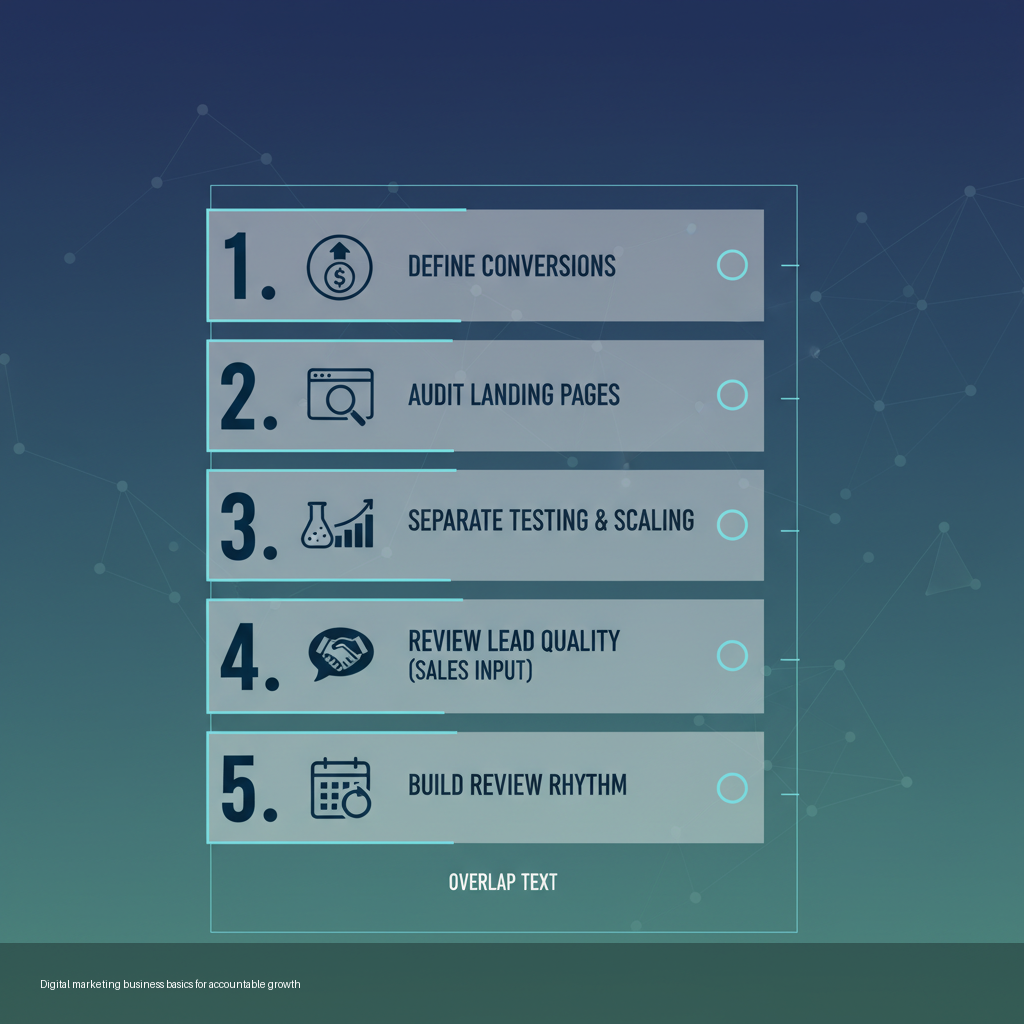
Before increasing ad budgets or expanding content production, telehealth organizations should check the foundation. More traffic can amplify existing weaknesses. A confusing service page, weak tracking setup, or difficult intake path may become more expensive once campaigns scale.
Step 1: Define the conversion clearly
Decide which action counts as a meaningful outcome before judging performance. This may be an appointment request, completed intake form, provider referral, demo request, app registration, or phone call.
Watch for: Reports that celebrate clicks without showing enquiry quality.
Useful check: Confirm that forms, calls, bookings, and relevant events are tracked in the same reporting view.
Step 2: Audit the landing page
Review the page that receives traffic before changing the campaign. The page should explain the service, audience fit, next step, and follow-up process clearly.
Watch for: Vague headlines, hidden calls to action, weak mobile layouts, unclear proof points, or confusing forms.
Useful check: Compare page behaviour by device, source, and conversion action.
Step 3: Separate testing from scaling
Run controlled tests before expanding spend across channels. This helps identify which message, audience, keyword, or page change caused the shift in performance.
Watch for: Teams changing ads, landing pages, audiences, budgets, and forms at the same time.
Useful check: Keep a simple log of campaign changes and review performance after enough data has collected.
Step 4: Review lead quality with operations or sales input
Marketing data should be checked against intake, care coordination, partner development, or sales feedback depending on the organization’s model.
Watch for: Campaigns with many submissions but low-fit enquiries.
Useful check: Tag leads by source, service interest, qualification status, and outcome where appropriate.
Step 5: Build a review rhythm
Set a recurring review cycle for performance, technical issues, content priorities, landing page tests, and conversion quality.
Watch for: Reports that show data but do not identify the next decision.
Useful check: End each review with a short action list, an owner, and a follow-up date.
Signs your telehealth marketing needs a reset
A reset is not a failure. It may simply mean the organization has outgrown older messaging, website structure, campaign targeting, or tracking. The warning signs often appear in operations before they appear in dashboards.
Common signs include rising spend without better lead quality, traffic growth without more appointment requests, inconsistent reporting between platforms, and landing pages that no longer match current services. Another signal is internal disagreement: leadership, marketing, intake, sales, or clinical teams may each see a different version of campaign performance.
Short-term fixes versus system fixes
A short-term fix may pause a weak ad group or rewrite a headline.
A system fix may rebuild tracking, revise landing pages, and connect lead quality back to source data.
Short-term fixes can help, but system fixes usually explain why performance changed.
The stronger path is usually to simplify first. Clean up tracking, define qualified outcomes, repair the highest-impact website issues, and then decide which channels deserve renewed investment.
Get clear advice before your next telehealth campaign
If your telehealth marketing reports feel busy but not useful, a structured review can reveal where the gaps are. Strong digital marketing should connect channel activity to patient, provider, partner, or buyer outcomes that matter to the organization.
For a practical review of your current channel mix, tracking setup, landing pages, and growth priorities, Book a Free Strategy Call.
FAQs About Digital Marketing for Telehealth
How do I know whether telehealth campaigns are being measured properly?
Campaigns are being measured properly when meaningful actions such as appointment requests, intake forms, phone calls, demo requests, or partner enquiries can be traced back to the correct channel and campaign. Reports should separate traffic activity from qualified outcomes.
Should a telehealth organization start with SEO or paid ads?
The better first step depends on the business problem. Paid ads can test demand and messaging faster, while SEO builds longer-term search visibility. Many telehealth organizations benefit from using paid search data to guide future SEO content and landing pages.
How can a website affect telehealth marketing performance?
A website affects performance through page speed, mobile usability, accessibility, message clarity, form placement, trust signals, and technical SEO. Strong traffic can still underperform if visitors cannot understand the service or complete the next step easily.
What should telehealth landing pages include?
Telehealth landing pages should clearly explain who the service is for, what problem it addresses, how the process works, what action to take, and what happens after submission. They should also support trust and reduce uncertainty without making unsupported claims.
How should a telehealth organization compare digital marketing agencies?
Compare agencies by how clearly they define conversions, explain reporting, connect channels, and handle technical website issues. A strong agency should make trade-offs visible and show how recommendations connect to qualified enquiries, appointments, sales conversations, or partner opportunities.