
Permanent Hair Removal in the Telehealth Era: What to Know Before You Book

Permanent hair removal is not a one-click decision. Even when research, screening questions, pricing discussions, and aftercare instructions can begin online, laser hair removal itself still requires an in-person appointment with trained providers and appropriate technology. For telehealth-minded patients, the goal is to use digital access to ask better questions before committing to a treatment plan.
A helpful starting point is Royal Laser Clinic’s original guide, Permanent Hair Removal With Less Guesswork, which explains why treatment planning should account for hair colour, hair thickness, skin tone, hormones, treatment area, comfort, and long-term touch-up needs.
For readers comparing cosmetic services through a telehealth lens, the key issue is understanding what can be handled remotely and what must be assessed in person. Education, intake forms, medical history review, preparation instructions, and follow-up questions may be discussed before the appointment. Skin assessment, laser settings, treatment comfort, and same-day suitability still need qualified in-clinic judgment.
Quick Facts: Laser Hair Removal Planning
Use online research and consultation tools to prepare, but expect treatment decisions to be confirmed in person.
- What it is: Laser hair removal targets follicles during active growth phases to reduce future regrowth over repeated sessions.
- What telehealth can support: Questions about goals, treatment areas, medical history, preparation, aftercare, pricing, and expectations.
- What requires a clinic visit: Skin and hair assessment, laser settings, contraindication review, and the laser treatment itself.
- Common treatment areas: Underarms, legs, face, bikini, Brazilian, back, chest, arms, and full body plans.
- Why planning matters: Hair growth cycles, hormones, skin tone, and treatment consistency all influence results.
Why Permanent Hair Removal Needs More Than a Package Price
Permanent hair removal usually refers to long-term laser hair reduction rather than the instant removal of every follicle in one visit. Hair grows in cycles, and laser energy works best when a follicle is in an active growth phase. That is why a planned series of sessions is needed.
From a telehealth perspective, this is where early education matters. A patient may want to know how many sessions will be needed, whether darker skin can be treated safely, whether laser will hurt, or whether hormonal hair growth can return. These questions should be answered before payment pressure begins.
Royal Laser uses the Soprano Ice system for Laser Hair Removal, including sensitive areas, larger body zones, and treatment plans for varied skin tones. Its model includes unlimited sessions until the desired outcome is reached and lifetime free touch-ups, which can be important for clients concerned about stubborn or future regrowth.
What Can Be Discussed Remotely Before Laser Hair Removal?
A virtual or phone-based pre-consultation can help patients organize the right questions before visiting a clinic. It should not replace an in-person assessment, but it can reduce confusion and make the first appointment more productive.
Useful topics for a remote pre-screening conversation
- Treatment goals: Whether the patient wants one area treated, multiple zones, or a full body plan.
- Hair history: Hair colour, density, shaving frequency, waxing history, and ingrown hair concerns.
- Skin considerations: Skin tone, recent tanning, sunburn, sensitivity, irritation, or use of self-tanner.
- Medical context: Hormonal conditions, medication use, pregnancy status, skin conditions, and contraindications that may require review.
- Preparation: When to shave, what products to avoid, and why waxing or plucking before laser can interfere with treatment.
- Aftercare: What to expect after a session and how to reduce irritation while the skin settles.
- Cost structure: Whether the clinic sells fixed packages or builds a plan around the patient’s response.
What Cannot Be Solved Through Telehealth Alone?
Laser treatment requires direct evaluation. A provider needs to see the treatment area, assess the skin on the day of service, confirm that the area is safe to treat, and choose settings based on the person’s skin, hair, and sensitivity.
Telehealth can help patients prepare, but it cannot confirm every risk through a screen. Recent sun exposure, irritation, active skin reactions, and product use may change whether treatment should proceed. A responsible clinic should be willing to delay treatment if the skin is not ready.
In-person checks that matter
- Skin tone and skin condition: Settings must be chosen carefully for safety and comfort.
- Hair type: Coarse, dark hair may respond differently than fine or light hair.
- Treatment area: Face, neck, bikini, Brazilian, and hormone-sensitive areas may need extra planning.
- Contraindications: Medications, recent procedures, or irritation may affect treatment timing.
- Comfort response: The provider should monitor sensation and adjust as appropriate.
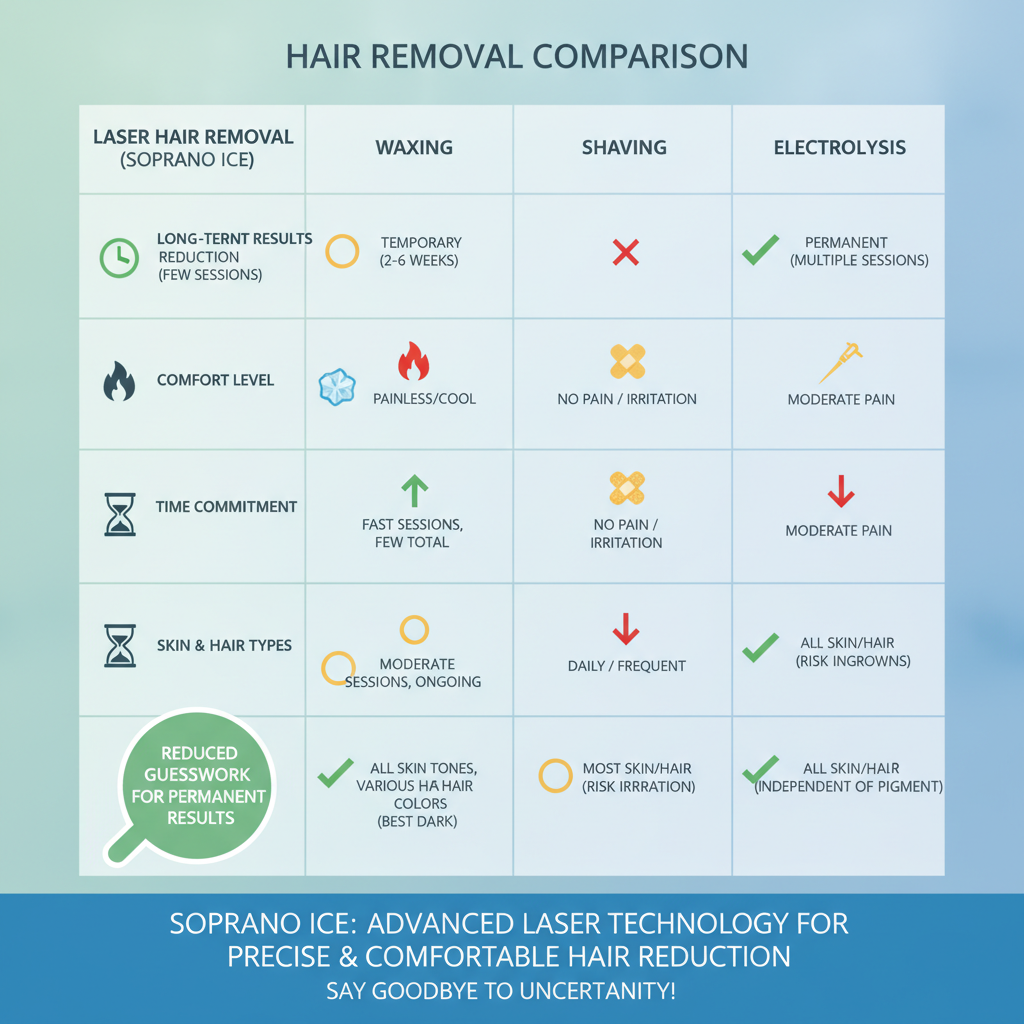
Laser Hair Removal Compared With Shaving, Waxing, and Electrolysis
Many patients begin their research by comparing laser with familiar options such as shaving and waxing. The best choice depends on the area, tolerance for maintenance, comfort, hair type, and long-term goals.
Laser hair removal
Laser hair removal uses energy to target hair follicles and reduce future growth over a planned series of treatments. It is commonly considered by people who want less shaving, fewer waxing appointments, and longer-term smoothness.
- Best fit: Patients who want structured long-term reduction rather than repeated temporary removal.
- Planning need: Multiple sessions are required because hair grows in cycles.
- Telehealth role: Remote education can help patients understand preparation, aftercare, and realistic expectations before coming in.
Shaving
Shaving cuts hair at the skin’s surface. It is fast and familiar, but it does not affect the follicle or reduce future growth.
- Best fit: Quick maintenance without an appointment.
- Common concern: Stubble, razor bumps, irritation, and frequent repetition.
- Telehealth role: A remote discussion may help patients decide whether recurring irritation is a reason to explore laser.
Waxing
Waxing removes hair from the root for temporary smoothness. The follicle remains active, so hair grows back and repeat appointments are needed.
- Best fit: Short-term smoothness before an event, trip, or seasonal change.
- Common concern: Discomfort, redness, regrowth requirements, and ingrown hairs.
- Telehealth role: Patients can ask when to stop waxing before beginning laser because laser needs the follicle target to remain present.
Electrolysis
Electrolysis treats individual follicles and may be considered for small areas or certain hair types. It can be slow for larger zones.
- Best fit: Isolated hairs or cases where laser may not be the preferred option.
- Common concern: Time commitment for larger areas.
- Telehealth role: A provider can explain whether laser or electrolysis may be worth discussing based on the patient’s goals.
Comfort, Skin Tone, and Technology Questions to Ask
Comfort is one of the most common concerns patients raise before laser hair removal. Older laser experiences are often described as sharp or snapping, which can make first-time patients anxious. Modern systems vary, so it is reasonable to ask what technology is used and how comfort is supported.
The Soprano Ice system is designed to use gradual heating with cooling support. Royal Laser uses this system for laser hair removal, including plans for all skin tones. However, technology alone is not enough. The provider still needs to choose settings carefully and assess the skin before each treatment.
Questions worth asking before treatment
- Is the device suitable for my skin tone?
- How do you adjust treatment for sensitive areas?
- What should I avoid before my appointment?
- What happens if I have recent sun exposure or irritation?
- How do you handle stubborn regrowth?
- Are touch-ups included, or will I need to buy more sessions later?
Hormonal Hair Growth Needs Realistic Planning
Telehealth conversations can be especially useful for patients dealing with recurring facial hair, PCOS-related hair growth, hirsutism, or other hormone-sensitive patterns. Laser can reduce treated hair growth, but hormonal triggers may continue to influence new growth over time.
This does not mean laser is not useful. It means expectations and support policies matter. Areas such as the face, neck, chest, bikini line, and Brazilian area may need more careful planning than a fixed package allows.
Patients should ask whether the clinic adjusts the plan based on response and whether future touch-ups are included. Royal Laser’s model includes lifetime free touch-ups, which can be relevant for clients who experience resistant or recurring growth.
Men’s Laser Hair Removal and Remote Planning
Men often seek laser treatment for the back, shoulders, chest, neck, beard line, or full body grooming. These areas may involve dense or coarse hair, and treatment planning may differ from smaller or less dense zones.
Laser Hair Removal for Men can be discussed before the first clinic visit so patients understand timing, preparation, and the difference between reducing unwanted growth and shaping a specific grooming pattern.
For beard line, neck, and shoulder treatments, it is especially important to clarify the desired boundaries before treatment begins. A remote conversation may help define goals, while the final treatment map should be confirmed in person.
Preparing for Your First Appointment
Preparation affects comfort and effectiveness. Patients should receive clear instructions before the first session, whether those instructions are delivered by phone, email, patient portal, or in person.
Common preparation guidance
- Shave the area as instructed: Shaving removes surface hair while keeping the follicle available for laser targeting.
- Avoid waxing and plucking: These methods remove the follicle target and may reduce laser effectiveness.
- Avoid heavy sun exposure: Recent tanning or sunburn may increase irritation risk.
- Skip self-tanner: Artificial pigment can affect treatment planning.
- Limit irritating products: Strong exfoliants or active skincare may need to be paused around treatment.
- Arrive with clean skin: Heavy lotions, oils, or fragranced products may interfere with treatment comfort.
Aftercare Support Is a Good Use of Digital Communication
Aftercare is one of the strongest fits for telehealth-style support. Patients may have questions about mild redness, warmth, exfoliation timing, product use, or when to schedule the next visit. Clear instructions help reduce uncertainty after leaving the clinic.
Patients should know who to contact if the treated area feels more irritated than expected or if they are unsure whether a product is safe to resume. A clinic that provides accessible follow-up guidance can make the treatment process feel more organized.
Aftercare topics to clarify
- How long warmth or redness may last
- When to resume exfoliation or active skincare
- How to protect the area from sun exposure
- When shedding may occur
- How the next appointment is timed around the hair growth cycle
Budget Questions: Look Beyond the First Session
Price matters, but the lowest first-session cost does not always explain the full treatment path. Hair reduction requires consistency, and different areas may respond at different speeds. A fixed package may not match every person’s needs.
Royal Laser’s pay-only-for-what-you-need model is designed to avoid forcing clients into preset bundles before their hair and skin response is understood. Patients can review Laser Hair Removal Prices and ask how treatment costs relate to the area, session structure, and long-term support.
Before booking, ask what happens if you need more visits than expected, whether touch-ups are included, and whether you can begin with one area before deciding on a larger plan.
Skin Confidence May Include More Than Hair Reduction
Some patients seek laser hair removal because shaving or waxing has contributed to irritation, bumps, or ingrown hairs. Others are also interested in tone, texture, hydration, or overall skin appearance.
Royal Laser also provides Facial Treatments, including OxyGeneo 3-in-1 Super Facial, classic facials, and microdermabrasion. These services are separate from laser hair removal, and timing should be planned carefully so the skin has enough time to recover between treatments.
Patients should ask whether skincare treatments can be safely scheduled near laser sessions, especially if the same area is being treated.
Choosing a Clinic: A Telehealth-Informed Checklist
Digital access makes it easier to compare clinics, but patients should still look for careful consultation standards rather than only convenience. A strong clinic should explain safety, comfort, preparation, expected progress, and touch-up policies before treatment begins.
Signals of a thoughtful laser hair removal provider
- Clear consultation process: The provider reviews skin tone, hair type, treatment area, goals, and contraindications.
- Appropriate technology: The device should be suitable for the patient’s skin tone and treatment area.
- Comfort planning: The clinic should explain what the treatment may feel like and how comfort is supported.
- No rushed package pressure: Patients should understand the plan before purchasing sessions.
- Regrowth policy: The clinic should explain how stubborn or future growth is handled.
- Aftercare access: Patients should know how to ask questions after treatment.
When You Are Ready to Book
Permanent hair removal works best when patients understand the process before committing. Telehealth-style communication can support education, screening, preparation, and aftercare, but laser treatment itself should be performed in person by qualified providers using appropriate technology.
Royal Laser and Skincare Clinic is a family-owned cosmetic clinic with certified aestheticians specializing in laser hair removal since 2010. The clinic uses FDA-approved Soprano Ice technology, offers complimentary consultations with the first session included, and supports clients with a results guarantee plus lifetime free touch-ups.
Plan Laser Hair Removal With Clear Next Steps
Ask Royal Laser about Soprano Ice treatment, preparation, all-skin-tone planning, lifetime touch-ups, and a plan based on your hair, skin, and goals.
FAQs About Permanent Hair Removal and Telehealth Planning
Can laser hair removal be done through telehealth?
No. Laser hair removal must be performed in person. However, telehealth-style communication can support education, pre-screening, preparation instructions, pricing questions, and aftercare guidance.
How many laser sessions will I need?
The number of sessions depends on the treatment area, hair thickness, skin tone, hormones, and appointment consistency. Hair growth cycles affect timing, so an in-person consultation is needed for a realistic plan.
Is Soprano Ice laser hair removal comfortable?
Soprano Ice is designed to combine gradual heating with cooling support. Sensation varies by area and person, but many patients ask about this system because comfort is a priority.
Can darker skin tones be treated safely?
Laser hair removal can be planned for varied skin tones when suitable technology and careful settings are used. A provider should assess skin tone, recent sun exposure, irritation, and the treatment area before starting.
What should I avoid before laser hair removal?
Avoid waxing, plucking, self-tanner, heavy sun exposure, and irritating skincare on the treatment area unless your provider gives different instructions. Shaving is usually preferred before laser because it keeps the follicle available for treatment.
Can laser help with ingrown hairs?
Laser may reduce the hair growth that contributes to ingrown hairs, especially in areas repeatedly affected by shaving or waxing. It may not clear every bump immediately, but reduced regrowth can mean less repeated irritation over time.
Related Topics:
- Permanent hair reduction
- Laser hair removal consultation
- Soprano Ice laser hair removal
- Laser hair removal preparation and aftercare
- Full body laser hair removal