
Online Marketing Agency Guidance for Telehealth and Toronto Healthcare Businesses
For telehealth clinics, virtual care platforms, allied health providers, and healthcare technology companies, digital growth is not only about getting more traffic. It is about helping the right patients, caregivers, referral partners, or healthcare buyers find clear, trustworthy information and take the next step with confidence. An online marketing agency can help organize SEO, paid media, website design, content, and analytics into one measurable system.
The broader principles behind choosing a marketing partner still apply across industries, and this guide builds on Zigma’s original article about online marketing agency advice for Toronto businesses. For telehealth organizations, however, the strategy needs extra attention to trust, privacy expectations, patient education, local search behaviour, and the difference between general awareness and appointment-ready demand.
That is why the right agency fit matters. A virtual clinic may need better organic visibility for service pages, a mental health practice may need clearer booking paths, and a healthcare SaaS company may need content that supports longer decision cycles. The goal is not simply “more marketing.” The goal is cleaner acquisition, better-qualified enquiries, and a website experience that supports safe, informed decision-making.
Why telehealth businesses look for an online marketing agency
Telehealth services often sit at the intersection of healthcare, technology, and local consumer search. Prospective patients may search for virtual appointments, online counselling, remote monitoring, prescription support, specialist access, or follow-up care. At the same time, providers need to communicate clearly without overpromising, creating confusion, or making sensitive topics feel transactional.
A capable online marketing agency helps connect those needs through search visibility, paid campaigns, landing page improvements, analytics, and content planning. If organic search presence is weak, SEO Services can help build stronger visibility over time. If a telehealth provider needs faster demand capture for a specific service line, paid search may play a larger short-term role.
The most useful agencies do not treat healthcare marketing like a generic retail campaign. They look at intent, service eligibility, user anxiety, conversion friction, local competition, and measurement quality before recommending channels or budgets.
What an online marketing agency does for telehealth brands
Day-to-day agency work usually starts with diagnosis. For a telehealth organization, that may include reviewing search visibility, website structure, mobile booking paths, form tracking, call tracking, content gaps, paid campaign waste, landing page clarity, and how leads or appointment requests are handled after submission.
Different healthcare models need different channel mixes. A local virtual care clinic may need google business profile optimization, local seo gta, service-specific landing pages, and stronger appointment tracking. A healthcare technology company may need content marketing toronto, technical SEO, product education pages, and lead nurturing assets. A private clinic offering virtual consultations may need Google Ads Management with careful keyword selection, negative keywords, and landing pages that match patient intent.
Good agencies also understand sequencing. If the website is confusing, forms are too long, or analytics are unreliable, increasing ad spend may only amplify the problem. In telehealth, trust and usability often need to be fixed before traffic growth becomes efficient.
How digital marketing changes for telehealth in Toronto, Ontario
Toronto search competition is dense and varied
Telehealth providers serving Toronto, Ontario compete in a crowded search environment. Patients and healthcare buyers often compare multiple providers before booking, requesting information, or speaking with a care team. This means digital marketing toronto execution must go beyond visibility. It must also create clarity, credibility, and a smooth path to action.
For healthcare-related searches, the page experience matters. Visitors may be evaluating whether a service is appropriate, how appointments work, what the next step involves, and whether the provider appears trustworthy. That makes conversion rate optimization toronto, page speed, mobile usability, and message clarity especially important.
Neighbourhood and service-area intent still matter
Even when care is delivered virtually, local relevance can influence user behaviour. Someone in downtown Toronto may search differently from someone in North York, Scarborough, Etobicoke, or elsewhere in the GTA. Some users look for convenience, while others want local familiarity, provincial context, or service availability in their area.
That is why a digital marketing agency toronto or marketing agency gta should understand how regional search intent shapes campaigns. For telehealth, the local layer can affect service pages, ad copy, eligibility messaging, local SEO structure, and lead qualification.
Healthcare marketing needs trust-focused execution
In many industries, a landing page can push urgency aggressively. In telehealth, the tone usually needs more balance. People may be searching during stressful moments, dealing with private concerns, or comparing care options carefully. A useful website explains the process, sets expectations, and makes the next step simple without creating pressure.
For some providers, website design toronto support is as important as advertising because the site itself may be limiting conversion. If appointment booking, service explanations, trust signals, or mobile layout are weak, paid and organic campaigns may underperform.
How to choose an online marketing agency for a telehealth business
Agency selection becomes easier when you focus on operating habits rather than broad promises. A strong partner should explain how they diagnose problems, prioritize channels, measure performance, and adapt campaigns based on actual lead or appointment quality.
For telehealth organizations, the agency should also understand that patient trust, service clarity, privacy expectations, and compliant communication are part of marketing performance. Strategy and execution need to work together.
Step 1: Define the healthcare growth goal
Clarify whether the priority is more virtual appointment requests, stronger visibility for a specific service, better quality leads, more referral partner enquiries, or improved efficiency from existing ad spend. This helps the agency avoid pitching every channel at once.
What to check: Ask how success will be measured through calls, forms, bookings, qualified enquiries, or pipeline quality.
What can go wrong: If the goal remains vague, reports may focus on traffic without showing whether the traffic supports real patient or business outcomes.
Step 2: Review healthcare-relevant channel depth
Many agencies list SEO, PPC, content, and social media. The difference is in the details. Ask how they handle technical seo services, search intent mapping, landing page testing, negative keyword management, local visibility, and content that supports informed healthcare decisions.
What to check: Look for clear processes around audits, campaign refinement, reporting, and website recommendations.
What can go wrong: Generic execution can attract broad traffic that does not match the service, location, or user need.
Step 3: Evaluate tracking and attribution carefully
Telehealth campaigns need reliable measurement. An agency should be comfortable with GA4, tag management, form tracking, call tracking, dashboarding, and the limits of attribution. They should also distinguish between useful conversions and low-quality actions.
What to check: Ask how conversions are verified, how primary and secondary actions are separated, and how lead quality is reviewed.
What can go wrong: A campaign may look healthy in analytics while the care team or sales team receives poor-fit enquiries.
Step 4: Treat the website as part of the care-access journey
The website is where interest turns into action. Telehealth pages should explain services clearly, reduce hesitation, work well on mobile, and make booking or enquiry steps easy to understand. Many organizations need both marketing support and Website Design & Development to improve conversion.
What to check: Ask how the agency approaches landing pages, booking flows, service-page structure, and design decisions tied to user behaviour.
What can go wrong: Even strong SEO or PPC traffic can stall if visitors reach pages that feel unclear, slow, or difficult to navigate.
Step 5: Assess communication before signing
Healthcare organizations need agency partners who communicate clearly, acknowledge limitations, and explain trade-offs. Strong communication is especially important when campaigns involve sensitive services, multiple stakeholders, or long approval processes.
What to check: Look for realistic timelines, transparent reporting, and direct explanations of what each channel can and cannot do.
What can go wrong: If early answers are polished but vague, accountability may become difficult once campaigns are active.
What affects ROI for telehealth marketing campaigns
Campaign ROI is rarely determined by one channel alone. In telehealth, performance is shaped by the connection between search intent, service messaging, landing page quality, booking friction, follow-up, and tracking accuracy.
A paid search campaign can seem expensive when the real problem is an unclear landing page. SEO can appear slow when technical issues prevent important service pages from being indexed or understood properly. Content can attract visitors but fail to convert if it does not guide users toward the appropriate next step.
For telehealth providers, ROI often improves when the full journey is reviewed: how people search, what they expect to see, what concerns they may have, how easily they can take action, and whether the organization can track which campaigns produce meaningful enquiries.
Key ROI drivers
- Intent fit: Appointment-ready searches should be separated from broad informational queries.
- Service clarity: Pages should explain who the service is for, what the next step involves, and how users can proceed.
- Landing page relevance: Ads and organic snippets should lead to pages that continue the same message without confusion.
- Tracking quality: Reliable conversion data helps budget decisions stay connected to real outcomes.
- Mobile experience: Many users research healthcare options on mobile, so page speed and form usability matter.
- Follow-up process: Marketing can generate interest, but slow or unclear response processes can weaken results.
SEO vs PPC for telehealth: when each strategy makes sense
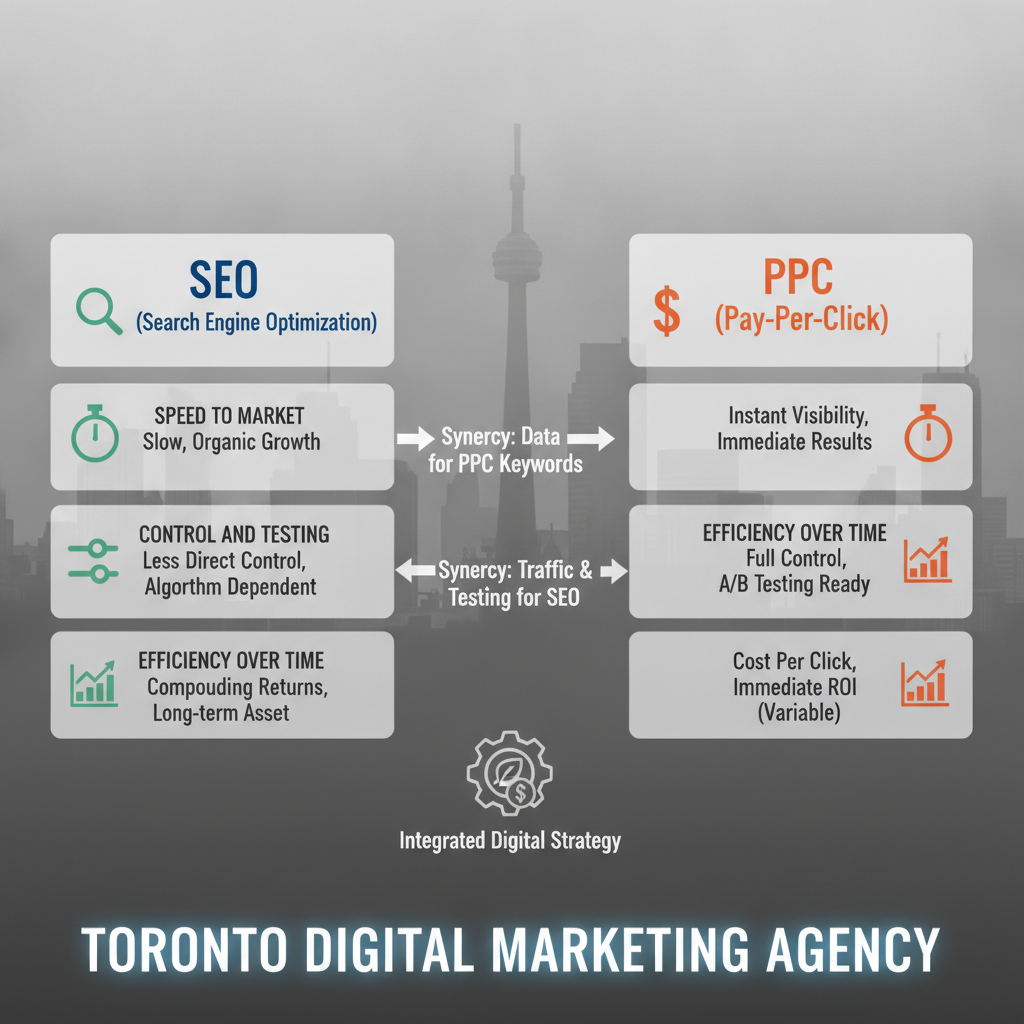
Telehealth businesses often ask whether SEO or PPC is the better investment. The stronger answer depends on timing, competition, service type, and measurement readiness. SEO supports durable visibility over time, while PPC can capture demand faster when campaigns are structured carefully.
Speed to market
A) SEO: SEO builds visibility gradually as technical issues, service pages, content, and internal links improve.
- How it works: The agency improves site structure, on-page relevance, local signals, and content quality.
- Best fit: Telehealth providers that want long-term visibility for recurring service searches.
- Example: A virtual clinic building service pages around different appointment types and locations served.
B) PPC: PPC can create visibility faster once tracking, targeting, and landing pages are ready.
- How it works: Ads appear for selected search terms, with control through keywords, bids, negatives, and ad copy.
- Best fit: Providers that need quicker demand capture for a specific service or seasonal need.
- Example: A telehealth brand promoting a newly available virtual consultation service.
C) Combined approach: SEO and PPC can work together when each has a defined role.
- How it works: PPC captures immediate demand while SEO builds broader non-paid visibility.
- Best fit: Organizations that need both short-term appointment flow and long-term acquisition efficiency.
Testing and message refinement
A) SEO: SEO supports durable content and service-page improvements, but testing cycles are usually slower.
- How it works: Changes are measured through rankings, organic traffic, engagement, and conversions over time.
- Best fit: Providers willing to improve technical foundations and educational content.
B) PPC: PPC can test messaging, service positioning, and landing page variations more quickly.
- How it works: Campaigns test keywords, ad copy, audiences, and pages against conversion data.
- Best fit: Telehealth teams that need faster feedback on service demand or booking messages.
C) Combined approach: Paid search data can inform SEO priorities, while SEO insights can sharpen PPC targeting.
Efficiency over time
A) SEO: SEO may improve acquisition efficiency over time when pages rank and convert consistently.
- How it works: Strong pages can keep attracting relevant users without paying for each click.
- Best fit: Providers focused on durable visibility and lower dependence on paid traffic.
B) PPC: PPC efficiency depends on query quality, landing page relevance, tracking accuracy, and active management.
- How it works: Performance improves through exclusions, bid control, ad testing, and landing page refinement.
- Best fit: Organizations that can monitor campaign quality and respond to lead data.
C) Combined approach: A mixed strategy can balance short-term visibility with long-term search growth.
How Toronto telehealth providers can compete online
Telehealth businesses do not need to copy the largest healthcare brands to compete. Smaller clinics, private practices, and specialized providers can often gain ground by being clearer, more specific, and more responsive.
Strong local digital execution may include service pages built around real search intent, location relevance where appropriate, clear appointment pathways, review and reputation signals, and reliable tracking. Paid campaigns should separate high-intent searches from broad informational searches so budgets are not wasted on poor-fit traffic.
Operational readiness also matters. If appointment requests are delayed, phone calls are missed, forms route incorrectly, or follow-up is unclear, marketing performance will suffer. Digital campaigns can open the door, but the patient or prospect experience must carry the interaction forward.
Where smaller telehealth businesses can gain ground
- Specific service pages: Build pages around clear appointment types, conditions, specialties, or virtual service categories where appropriate.
- Local relevance: Reflect Toronto and GTA service areas naturally when location context helps the user.
- Trust signals: Clear provider information, process explanations, reviews, and transparent next steps can reduce hesitation.
- Mobile-first booking: Forms, buttons, and appointment paths should be easy to use on smaller screens.
- Lean testing: Headlines, calls to action, form length, and ad structure can often be improved without a full website rebuild.
Signals experienced healthcare marketers monitor
- Traffic quality over traffic volume: A smaller audience that books or enquires appropriately is more valuable than broad traffic that does not match the service.
- Search query detail: PPC search terms can reveal whether campaigns are attracting patient-ready intent or unrelated research traffic.
- Landing page behaviour: High drop-off may indicate unclear messaging, weak trust signals, slow pages, or confusing booking steps.
- Technical barriers: Indexing issues, duplicate pages, slow templates, and tracking errors can quietly limit growth.
- Lead quality feedback: Marketing reports should be compared with real appointment or sales outcomes whenever possible.
Practical takeaways before hiring an agency
An online marketing agency is most valuable when it can diagnose the real growth constraint, connect channels into one measurement system, and improve the website experience that turns search interest into qualified enquiries or bookings.
For telehealth and healthcare businesses in Toronto, Ontario, that usually means balancing SEO, PPC, local visibility, content quality, conversion design, and attribution. The agency should understand both digital growth and the trust-sensitive nature of healthcare decisions.
If your organization needs support with Digital Marketing Services, Zigma Internet Marketing offers SEO, PPC, web, content, and analytics support with reporting and conversion-focused execution. 📩 Ask an SEO/PPC question.
FAQs About Online Marketing Agencies for Telehealth
Do telehealth providers need a specialized online marketing agency?
Not always, but the agency should understand healthcare-related search behaviour, trust-building content, privacy expectations, and the importance of clear service messaging. Generic marketing tactics may not fit the way people evaluate virtual care options.
Is SEO or PPC better for a virtual clinic?
It depends on timing and goals. SEO is better suited to building durable visibility over time, while PPC can help capture demand more quickly. Many telehealth providers benefit from using both with distinct roles.
What should a Toronto telehealth business ask during an agency evaluation?
Ask how the agency handles local search competition, healthcare service pages, conversion tracking, landing page improvements, and lead quality reporting. For Toronto and the GTA, it is also useful to ask how they approach regional search intent.
Can digital marketing improve appointment bookings?
Digital marketing can improve visibility and make it easier for the right users to take action, but results also depend on the website experience, tracking setup, service clarity, and follow-up process.
Does local SEO matter for telehealth if appointments are virtual?
Usually, yes. Even virtual services may be searched with local intent, especially when users want providers familiar with their region, availability, or healthcare context. Local relevance can support both visibility and trust.
Related Topics:
- telehealth SEO
- healthcare PPC advertising
- local search marketing for clinics
- conversion optimization for virtual care
- analytics and tracking setup