
HVAC marketing agency guidance for better lead quality
What telehealth marketers can teach an HVAC marketing agency about lead quality
Telehealth teams understand that demand generation is only useful when it leads to the right next step: a completed intake, a booked appointment, a matched provider, or a patient who can be properly supported. The same principle applies to home-service marketing. An HVAC marketing agency should not be judged only by traffic, clicks, or form volume. It should be judged by whether it can help heating and cooling companies attract enquiries that can become qualified repair, replacement, installation, or maintenance jobs.
For readers who follow patient acquisition, digital intake, and appointment conversion, HVAC marketing offers a useful parallel: urgent need, local intent, trust barriers, and operational capacity all affect results. This broader discussion builds on HVAC marketing agency guidance for better lead quality, with a focus on what telehealth-style measurement and intake thinking can add to service-business lead generation.
In both telehealth and HVAC, a campaign can look successful in an ad platform while failing in the real world. A person may click an ad but abandon the page, call after hours, submit the wrong type of request, or live outside the service area. The job of marketing is not just to create activity. It is to connect demand with a response system that can qualify, route, and convert it.
Why lead quality matters more than raw lead volume
Telehealth providers often separate patient journeys by condition, urgency, appointment type, insurance or payment path, and provider availability. HVAC companies need similar segmentation. A no-heat emergency, a planned furnace replacement, an AC tune-up, and an indoor air quality enquiry should not be treated as identical conversions.
A strong HVAC marketing agency should help separate these intent types before budget decisions are made. Emergency repair campaigns need fast contact options and reliable call tracking. Replacement campaigns need more educational content, comparison pages, trust signals, and forms that collect project details. Maintenance campaigns may depend more on repeat visibility, reminders, and follow-up than on a single ad click.
This is where digital marketing services such as SEO Services, paid search, landing page improvement, and analytics need to work together. Search visibility can build steady demand over time, while paid campaigns can help prioritize urgent services, seasonal needs, or specific service areas.
Telehealth-style intake thinking for HVAC campaigns
Telehealth intake is designed to determine whether a patient is a good fit, what care path they need, and how quickly they should be routed. HVAC lead systems benefit from the same mindset. The question is not simply, “Did someone contact us?” The better question is, “Can the team act on this enquiry and connect it to a real service opportunity?”
Useful HVAC lead evaluation should include signals such as:
- Service category: Repair, replacement, installation, tune-up, maintenance plan, and indoor air quality leads should be tracked separately.
- Urgency: Emergency repair enquiries need different routing and response expectations than planned replacement research.
- Location fit: Leads outside the company’s service area can inflate volume while reducing real opportunity.
- Contact quality: Missed calls, duplicate forms, incomplete submissions, and low-duration calls can reveal friction in the intake process.
- Job progression: Booked visits, proposals, installations, and maintenance agreements provide better feedback than raw form counts.
For telehealth readers, this is familiar. A digital front door is only effective when it guides the right person to the right next action. HVAC marketing works the same way.
How SEO, PPC, and conversion optimization work together
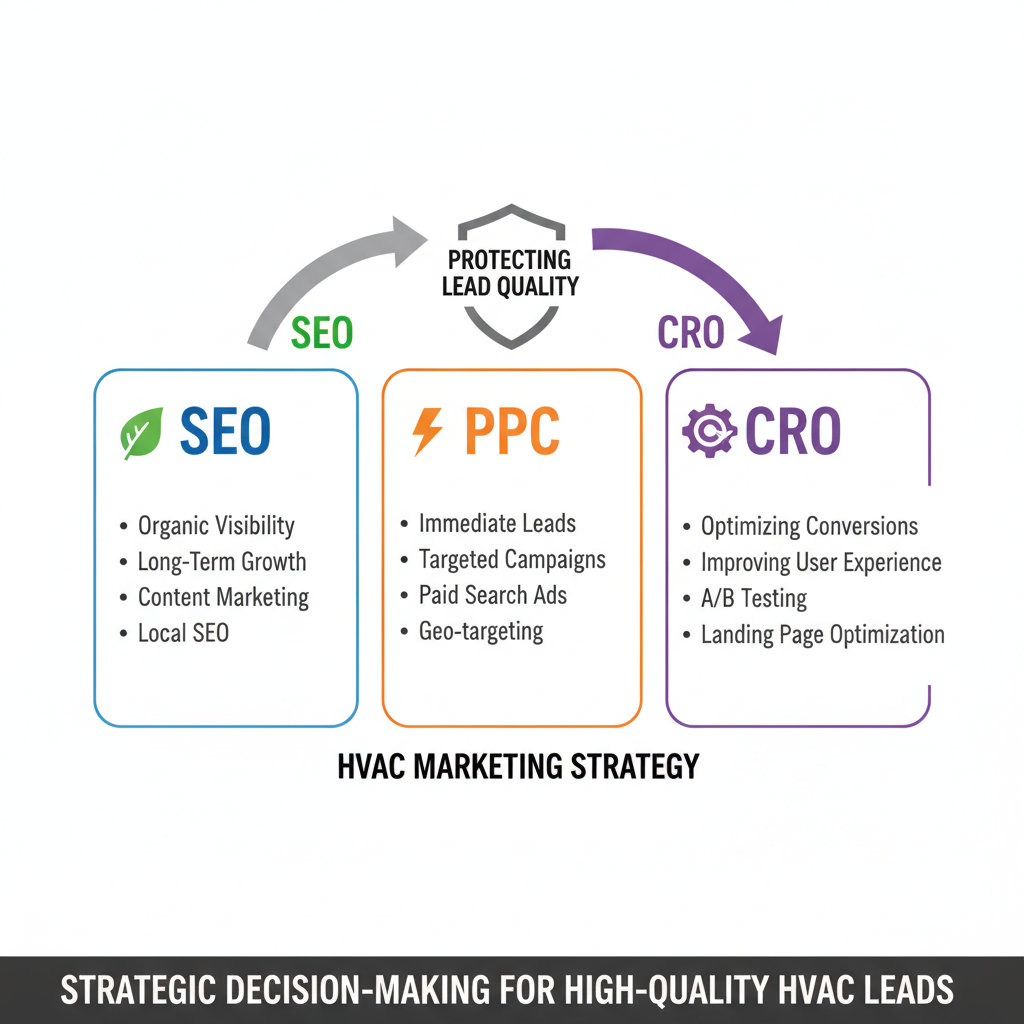
An HVAC marketing agency should not present SEO, PPC, and conversion rate optimization as isolated tactics. They are parts of one lead-quality system. Telehealth organizations often combine search visibility, paid acquisition, scheduling flows, and patient experience design; HVAC companies need the same joined-up approach.
SEO for durable service demand
SEO helps HVAC companies build long-term visibility for service pages, educational content, and local search queries. A strong SEO plan should make it clear which services the company offers, where it operates, and why a homeowner should trust the business.
- Service pages: Dedicated pages for furnace repair, AC installation, heat pumps, ductless systems, and maintenance plans help match search intent.
- Educational content: Guides can support buyers who are comparing systems, researching symptoms, or deciding whether repair or replacement makes sense.
- Technical SEO: Page speed, crawlability, structured data, internal linking, and clean site architecture help search engines understand the site.
PPC for controlled lead flow
Paid search can help HVAC companies manage visibility when demand changes quickly. This is especially important for emergency repair, seasonal campaigns, or service lines that need immediate attention.
- Search ads: Campaigns can target high-intent searches by service, location, device, and schedule.
- Remarketing: Past visitors can be reminded about replacement consultations, maintenance plans, or service details.
- Negative keywords: Search term reviews can reduce wasted spend on jobs, manuals, parts, training, and DIY queries.
CRO for better conversion paths
Conversion rate optimization protects both SEO and PPC investment. If a page is slow, confusing, or difficult to contact from a mobile device, the marketing channel may be blamed for a website problem.
- Landing page structure: Repair pages should make phone contact, service availability, and next steps easy to find.
- Form design: Forms should collect enough detail to qualify the request without creating unnecessary friction.
- Call tracking: Phone enquiries should be tied back to campaigns, pages, and search terms whenever possible.
What a telehealth audience should notice when evaluating an HVAC marketing agency
Telehealth leaders are used to evaluating digital systems through the lens of access, routing, compliance, patient experience, and operational capacity. While HVAC is not healthcare, the same operational discipline can help identify whether an agency understands lead quality.
A useful agency should ask practical business questions before scaling campaigns. Which services are most profitable? Which service areas matter most? How quickly can calls be answered? Are installers available? Are repair technicians fully booked? Which enquiries are easy to close, and which ones waste the team’s time?
Those questions matter because a campaign can generate more demand than the business can handle. In telehealth, that may mean appointment bottlenecks. In HVAC, it may mean missed calls, delayed callbacks, poor scheduling, or too many low-fit enquiries.
Questions worth asking before choosing a partner
- How will repair, replacement, and maintenance leads be tracked separately? Separate tracking prevents one strong category from hiding weak performance elsewhere.
- How will phone calls be measured? Call source, call duration, missed calls, and booked-visit outcomes are important for HVAC lead quality.
- Which campaigns should launch first? A practical answer should consider demand, margins, seasonality, website readiness, and team capacity.
- How will wasted ad spend be reduced? Negative keywords, landing page alignment, location targeting, and search term reviews should be part of the plan.
- What will reporting show beyond clicks? Reporting should connect spend, calls, forms, qualified leads, booked visits, and sales feedback.
What affects return from HVAC lead generation
Return from HVAC marketing depends on more than ad budget. Website clarity, call handling, service-area fit, response speed, sales follow-up, offer structure, and job profitability all influence campaign value. The same is true in telehealth, where acquisition performance depends on intake, scheduling, provider availability, and follow-up workflows.
For HVAC companies, the most useful reporting connects marketing activity to operational outcomes. If calls are missed after hours, ad scheduling may need adjustment. If forms lack service details, the form may need refinement. If paid search brings repair calls but not replacement projects, campaigns and landing pages may need to be split more clearly.
Metrics to review together
- Qualified lead volume: Total conversions are less useful if many enquiries are outside the service area or unrelated to paid work.
- Cost per qualified lead: This is more meaningful than cost per click because it accounts for lead fit.
- Call answer rate: Missed calls can make a campaign look weak even when demand is present.
- Lead-to-booked-visit rate: This helps identify whether the issue sits in marketing, qualification, scheduling, or sales follow-up.
- Conversion rate by service page: Comparing repair, installation, and maintenance pages can show where visitors hesitate.
- Search term quality: Reviewing actual paid search queries helps reduce spend on low-intent traffic.
SEO vs PPC for HVAC: a practical view
SEO and PPC should not be treated as competitors. SEO builds durable visibility for service pages, educational content, and local trust signals. PPC provides faster control over which services receive visibility, when ads appear, and where traffic is sent.
An HVAC company with a weak website may need foundational SEO and conversion work before increasing ad spend. A company with strong service pages but seasonal demand swings may use PPC to support specific categories during peak periods. The right balance depends on how urgently the business needs enquiries and how ready the website is to convert them.
For organizations comparing support models, Google Ads Management and Website Design & Development should be reviewed alongside content strategy and analytics. HVAC lead quality often improves when channel strategy and website experience support the same business goal.
Common mistakes that weaken HVAC marketing
Many HVAC marketing problems come from small gaps that compound over time. The ad may be acceptable, but the page may be too generic. The form may generate volume, but not enough qualification. The call may come in, but the team may miss it. These are not just marketing problems; they are intake and operations problems.
- Sending all traffic to the homepage: A person searching for AC repair, furnace replacement, or maintenance plans should land on a page that matches that need.
- Counting every enquiry equally: A low-fit form submission should not be valued the same as a homeowner ready to schedule service.
- Ignoring call handling: Missed calls, delayed callbacks, and unclear intake questions can reduce campaign value.
- Publishing thin service pages: Pages that list services without explaining process, trust factors, or next steps often underperform.
- Reviewing platform data without sales feedback: Ad platforms can show conversions, but the sales or dispatch team can explain which leads were actually workable.
FAQs about choosing an HVAC marketing agency
How can an HVAC company tell whether an agency is tracking the right leads?
A strong setup tracks calls, forms, booked visits, and lead quality by service type. Repair, replacement, maintenance, and indoor air quality enquiries should be separated so reporting shows useful demand, not just raw activity.
Should HVAC companies run ads before improving their website?
Ads can create traffic quickly, but a weak website can waste that traffic. If pages load slowly, lack service detail, or make contact difficult, website and conversion improvements should happen before or alongside paid campaigns.
Which metrics should HVAC owners review first?
Start with qualified lead volume, cost per qualified lead, call answer rate, booked-visit rate, and conversion rate by service page. These metrics connect marketing activity to operational results more clearly than clicks or impressions alone.
Can one agency manage SEO, PPC, landing pages, and analytics together?
Yes, if the agency has the technical and strategic depth to connect those areas. HVAC lead generation often improves when search visibility, paid campaigns, landing pages, tracking, and reporting are managed as one system.
A more accountable way to think about HVAC lead quality
Telehealth teams know that digital growth depends on more than acquisition. The same is true for HVAC companies. The strongest systems define service priorities, track intent accurately, make contact easy, and use feedback from real conversations to improve campaigns.
Zigma Internet Marketing works across SEO, PPC, web design, content, analytics, dashboards, and conversion optimization. For HVAC companies that want clearer lead quality reporting, a connected approach can make it easier to understand which campaigns create calls, forms, booked visits, and sales opportunities.
Need a clearer view of HVAC lead quality?
Ask how SEO, PPC, landing pages, and analytics can work together for a more accountable lead generation system.