
Digital Marketing Companies Near Me: How to Choose Wisely
How telehealth providers should evaluate digital marketing companies near me
When a clinic, virtual care platform, private practice, or healthcare startup searches for digital marketing companies near me, the goal is rarely just to find a nearby vendor. In telehealth, the real need is a marketing partner that can help patients understand services, book confidently, and move through a compliant, accessible digital journey.
Local visibility can be useful, especially when a telehealth provider also serves patients in specific cities, provinces, or regions. However, proximity does not prove healthcare marketing expertise. A helpful starting point is this original guide on how to choose digital marketing companies near me wisely, which emphasizes proof, clarity, and business outcomes over surface-level visibility.
For telehealth organizations, that same idea becomes even more important. Marketing should not only produce clicks or impressions. It should support appointment requests, patient education, service discovery, intake form completions, calls, qualified enquiries, and better understanding of which channels are helping people take the next step.
Quick Facts: Choosing a Digital Marketing Company for Telehealth
Use this checklist before comparing agencies.
- What: A digital marketing company helps manage online visibility, patient acquisition channels, website improvements, paid campaigns, SEO, content, analytics, and conversion paths.
- Who: Telehealth providers should look for teams that understand service-based marketing, patient intent, appointment funnels, accessibility, and clear reporting.
- Where: “Near me” can help identify agencies with local market awareness, but process, communication, tracking, and execution quality matter more than distance.
- How: Strong agencies use search strategy, landing pages, campaign testing, analytics, call or form tracking where appropriate, and ongoing optimization.
- Why: Better agency selection helps reduce wasted ad spend, unclear reporting, weak patient journeys, and campaigns that generate traffic without meaningful appointments or enquiries.
Why telehealth marketing needs more than generic agency support
Telehealth marketing has a different level of sensitivity than many other industries. A patient may be searching for care while feeling uncertain, rushed, embarrassed, or overwhelmed. The website, ads, service pages, and booking flow must make the next step clear without overpromising or creating confusion.
A capable marketing company should understand how SEO, paid search, website design, content, analytics, and conversion paths work together. For telehealth, that means helping people find the right service, understand availability, confirm whether the provider fits their needs, and complete the appropriate contact or booking action.
Zigma Internet Marketing offers Digital Marketing Services that combine planning, implementation, reporting, and ongoing improvement. For healthcare and telehealth organizations, the main lesson is to choose a partner that can explain both marketing activity and the patient-facing outcome it is meant to support.
What digital growth looks like for a telehealth practice
A digital marketing company creates growth by improving how people discover, evaluate, and contact a telehealth provider online. Search engine optimization can help service pages appear for relevant queries. Paid search can support faster visibility for specific appointment types or services. Website and conversion improvements can make booking, calling, or completing a form easier for visitors.
The most useful marketing strategy follows a cause-and-effect chain. Better targeting brings more relevant visitors. Better service pages reduce uncertainty. Better tracking shows which campaigns produce appointment requests, phone calls, form submissions, or other meaningful actions. Without that chain, marketing reports may show activity without explaining whether patient acquisition is improving.
For example, SEO Services should not only focus on ranking for broad healthcare terms. Effective SEO also considers search intent, page structure, technical health, location relevance, internal links, content quality, and the steps a visitor must take before contacting the provider.
Agency signals that matter for telehealth teams
Strong agency signals are often visible before a proposal is signed. A capable digital marketing company asks about services, patient types, booking workflows, geographic coverage, intake steps, capacity, sales or care coordination processes, and current analytics. A weaker agency may recommend channels before understanding how the organization actually receives and qualifies enquiries.
For telehealth providers, the agency should be able to explain recommendations in practical terms. If the agency suggests Google Ads, can the team discuss keyword intent, exclusions, conversion tracking, landing page alignment, and budget pacing? If the agency suggests SEO, can the team explain technical issues, service-page gaps, patient questions, and how progress will be evaluated?
- Clear measurement plan: The agency should define meaningful conversions such as calls, appointment requests, intake forms, consultation bookings, or qualified enquiries.
- Healthcare-aware messaging: Campaigns should be clear, accurate, and appropriate for people seeking care or health-related information.
- Implementation ability: Strategy matters, but someone must also update pages, install tracking, improve forms, fix technical issues, and test campaign copy.
- Reporting clarity: Reports should connect spend, traffic, conversion actions, enquiry quality, and next steps rather than listing disconnected metrics.
Comparing SEO, PPC, website work, and analytics for telehealth
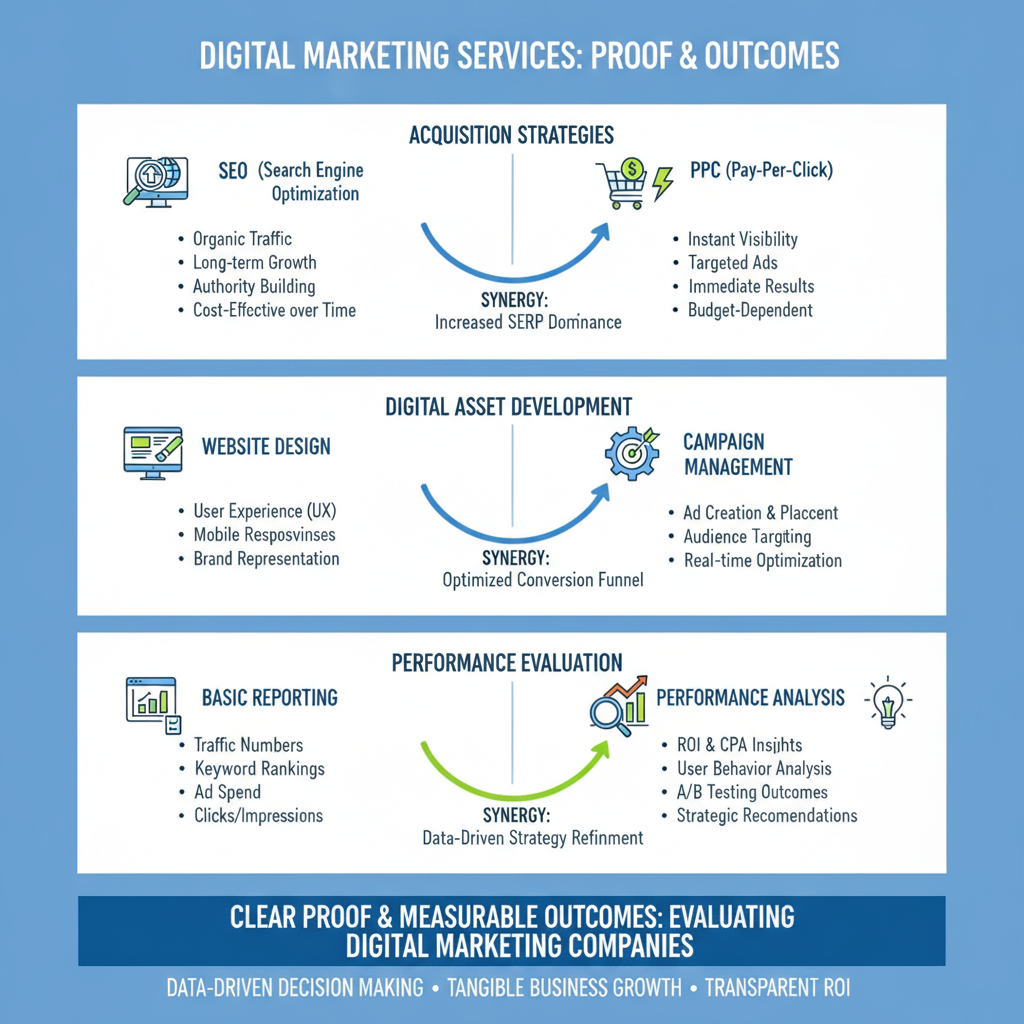
Different digital marketing services solve different patient acquisition problems. A telehealth provider needing immediate appointment demand may consider paid search. A clinic with weak organic visibility may need SEO and educational content. A provider receiving traffic but few enquiries may need landing page, form, and analytics improvements before increasing ad spend.
SEO compared with paid search for telehealth
A) SEO: SEO improves organic visibility by strengthening technical performance, service pages, content, internal links, and search intent alignment.
- How it works: SEO helps pages answer patient questions and become easier for search engines to understand.
- Best fit: SEO fits providers that want long-term visibility for services, conditions, appointment types, and location-specific searches.
- Example: A virtual therapy, dermatology, urgent care, or specialist service page may need clearer headings, FAQs, eligibility details, and stronger internal links.
B) PPC: PPC can place ads in front of people searching for relevant care options more quickly.
- How it works: Campaigns target selected queries, manage bids, filter irrelevant searches, and track conversion actions.
- Best fit: PPC fits providers that need faster visibility, have clear service availability, and can monitor lead quality actively.
- Example: Paid search can help test which service categories generate relevant appointment requests before expanding organic content.
C) Combined SEO and PPC: Using both channels can help telehealth teams learn faster while building longer-term visibility.
- How it works: PPC search term data can inform SEO priorities, while SEO pages can improve landing page relevance.
- Best fit: A combined strategy fits providers that want near-term feedback and durable organic growth.
- Example: If paid search reveals that one appointment type receives stronger interest, that insight can guide service-page development.
Website work compared with campaign management
A) Website design: Website work shapes how patients understand services, trust the provider, and take action.
- How it works: Design improves navigation, mobile usability, service clarity, page speed, calls to action, and booking paths.
- Best fit: Website improvements fit providers with outdated pages, confusing service information, or low enquiry rates despite traffic.
- Example: A telehealth landing page may need clearer service descriptions, shorter forms, prominent appointment buttons, and faster mobile loading.
B) Campaign management: Campaign management focuses on attracting qualified visitors through paid search, organic content, social campaigns, or other channels.
- How it works: Campaign work tests audiences, keywords, messaging, budgets, and landing pages.
- Best fit: Campaign management fits providers that already have a credible website and need more qualified appointment demand.
- Example: A paid campaign may need tighter keyword controls and better landing page alignment to reduce irrelevant clicks.
C) Website and campaign alignment: The strongest marketing decisions often happen when traffic generation and conversion improvements are managed together.
- How it works: Campaign data identifies visitor behaviour while website updates remove friction from the booking or enquiry path.
- Best fit: Alignment fits providers that are spending on ads but seeing too few qualified patient enquiries.
- Example: A campaign may generate clicks, but unclear appointment options or a slow mobile page can prevent visitors from converting.
Reporting compared with useful performance analysis
A) Basic reporting: Basic reports list sessions, impressions, clicks, rankings, or platform activity.
- How it works: Data is pulled from platforms and presented in a recurring format.
- Best fit: Basic reporting may help monitor visibility, but it rarely explains what should change next.
- Example: A report may show traffic growth without showing whether visitors requested appointments.
B) Performance analysis: Analysis connects metrics to practical questions about patient acquisition and service demand.
- How it works: Analysis reviews conversion paths, lead quality, search terms, landing page behaviour, and campaign efficiency.
- Best fit: Performance analysis fits telehealth teams deciding where to invest budget and operational attention.
- Example: Analysis may show that mobile visitors abandon a form, leading to a shorter form and clearer appointment instructions.
C) Dashboard plus action plan: A dashboard becomes more useful when it is paired with next steps, owners, and review timelines.
- How it works: KPIs are monitored while the agency translates patterns into SEO, ad, content, or landing page changes.
- Best fit: This structure fits providers that want accountability and a consistent improvement rhythm.
- Example: A dashboard may show rising cost per enquiry, while the action plan addresses search term waste and landing page friction.
Questions telehealth providers should ask before hiring an agency
A good agency conversation should feel structured, specific, and easy to understand. You do not need to know every technical term, but you should understand why a channel is being recommended and how success will be measured. Ask questions that reveal how the agency thinks, not just what services it sells.
Question 1: Which patient acquisition outcome are we improving first?
This question separates marketing activity from strategy. A clear answer may focus on more appointment requests, stronger enquiry quality, better tracking, improved service-page visibility, or reduced wasted ad spend.
Watch for: Answers that focus only on rankings, impressions, or clicks without explaining how those metrics connect to appointments or qualified enquiries.
Example: If a telehealth site already receives traffic but few bookings, conversion improvements may deserve attention before a larger ad budget.
Question 2: How will tracking be set up and reviewed?
Tracking is the measurement foundation. A serious agency should discuss analytics, tag management, form tracking, call tracking where appropriate, booking actions, dashboard reporting, and regular checks for accuracy.
Watch for: Reports that show traffic but cannot identify which channel, page, or campaign produced meaningful actions.
Example: A provider may think campaigns are underperforming when the actual issue is that appointment form submissions are not being tracked correctly.
Question 3: What needs to improve on the website?
Traffic alone rarely fixes a weak patient journey. The agency should review mobile usability, page speed, service clarity, appointment calls to action, forms, navigation, and trust-building content.
Watch for: Campaign recommendations that ignore the landing page experience.
Example: Paid traffic sent to a general homepage may convert poorly compared with traffic sent to a focused telehealth service page.
Question 4: How often will the strategy be adjusted?
Digital campaigns need review cycles. Search behaviour changes, service demand shifts, competitors adjust, and patient behaviour varies across devices and locations.
Watch for: Plans that describe setup but say little about testing, measurement, and refinement.
Example: A PPC account may need negative keyword updates, budget reallocation, ad copy tests, and landing page changes after early data is reviewed.
Question 5: Who is responsible for execution?
Strategy, implementation, content, development, analytics, and reporting require different skills. Ask who handles each part of the work and how communication will happen.
Watch for: A vague team structure where no one is clearly accountable for execution quality.
Example: Improving a telehealth service page may require SEO input, copy updates, developer support, analytics setup, and campaign alignment.
What affects ROI in telehealth digital marketing
Return on investment in telehealth marketing is shaped by more than traffic volume. Campaign performance depends on intent quality, landing page clarity, appointment availability, service fit, response process, tracking accuracy, and how quickly insights become action.
A campaign can look active in a report while still producing limited practical value. For example, broad informational traffic may not lead to appointments. A slow booking page may discourage visitors. A confusing form may reduce completions. Missing tracking may hide the channels that are actually working.
Useful ROI conversations often begin with two questions: which enquiries are valuable, and which marketing actions influence those enquiries? Without those answers, budget decisions become guesswork.
Campaign factors that can change performance
- Intent quality: Search terms with clear service or appointment intent are usually more useful than broad informational searches.
- Landing page fit: The page should match the ad or search query so visitors immediately understand the service and next step.
- Tracking accuracy: Calls, forms, booking clicks, and enquiry sources should be measured consistently where appropriate.
- Operational alignment: Marketing can be limited if enquiries are not answered, routed, or qualified efficiently.
- Testing rhythm: Campaigns improve when keywords, ad copy, page content, forms, and conversion paths are reviewed regularly.
SEO vs PPC for telehealth: where each strategy fits
SEO and PPC are often compared as if one must replace the other. For telehealth, a better comparison is timing, control, and patient intent. SEO builds organic visibility through content, technical health, service pages, and authority signals. PPC provides faster placement and more control over which searches trigger visibility, but paid traffic stops when campaigns pause.
SEO can be a stronger fit when a provider needs long-term visibility for services, locations, educational content, and recurring search demand. PPC can be a stronger fit when a provider needs faster testing, controlled traffic, or visibility for specific appointment types. Many telehealth teams can benefit from using both when tracking and landing pages are set up correctly.
Zigma Internet Marketing manages Google Ads Management alongside SEO, web development, content, and analytics. This combined view matters because poor campaign performance is not always an ad problem. Sometimes the issue is page speed, form friction, unclear messaging, or a mismatch between search intent and the landing page.
Why website and conversion work matter in virtual care
Many telehealth marketing issues are website issues in disguise. If a site loads slowly, hides service details, uses unclear appointment language, or makes forms difficult to complete, more traffic may simply send more people into the same friction.
A conversion-focused telehealth website does not need to be complicated. It needs clear service pages, honest explanations, strong mobile usability, visible contact or booking paths, and analytics that confirm whether visitors are taking meaningful actions. The same principle applies to patient intake flows, service selection pages, and campaign landing pages.
If a website is limiting performance, Website Design & Development can support SEO, paid campaigns, and conversion improvements together. The key is to treat the website as part of the patient acquisition system, not just a digital brochure.
A trust check before choosing digital marketing companies near me
Before choosing from digital marketing companies near me, telehealth providers should look for trust signals tied to execution quality. A useful agency should explain strategy clearly, connect campaigns to meaningful actions, support technical implementation, and report on outcomes that matter to the organization.
Zigma Internet Marketing brings Google Partner-certified expertise and full-service delivery across SEO, PPC, web, content, social media, analytics, and performance reporting. For telehealth teams, that kind of integrated support can help reduce the gap between strategy, implementation, and measurement.
If you want a second set of eyes on your current marketing setup, you can reach Zigma Internet Marketing at (647) 556-6071 or info@zigma.ca. You can also request a practical strategy conversation here: Book a Free Strategy Call.
FAQs About Digital Marketing Companies Near Me for Telehealth
How should a telehealth provider compare digital marketing companies near me?
Compare agencies by how clearly they explain strategy, tracking, implementation, and reporting. A strong agency should connect SEO, PPC, website work, content, and analytics to outcomes such as appointment requests, qualified enquiries, and service-page visibility.
Does a telehealth company need a local agency?
Not always. A local agency can help with regional knowledge and communication, but capability matters more than proximity. Look for healthcare-aware messaging, clear analytics, technical skill, and a practical improvement process.
How long does digital marketing take to show useful signals?
Paid campaigns can produce early traffic and conversion data quickly, while SEO usually requires a longer improvement cycle. Useful signals include search term quality, landing page behaviour, tracking accuracy, and whether enquiries match the provider’s services.
Should SEO and PPC be managed together for telehealth?
Managing SEO and PPC together can work well when data is shared between channels. PPC can reveal high-intent searches, while SEO can strengthen pages that support long-term visibility. The key requirement is clear reporting across both channels.
Why do some marketing reports feel unclear?
Reports feel unclear when they focus on activity instead of decisions. Clicks, impressions, and rankings can be useful, but they need context. Better reporting explains what changed, what the data suggests, and what action should happen next.
What should a telehealth provider prepare before speaking with an agency?
Prepare your website, main services, target patient groups, geographic coverage, booking or intake process, current campaign data, and analytics access if available. Clear context helps the agency recommend the right mix of SEO, PPC, website, content, and analytics work.
