
How Telehealth Providers Can Identify the Best Digital Marketing Agencies
For telehealth clinics, virtual care platforms, remote patient monitoring companies, and healthcare service providers, marketing has to do more than generate clicks. It needs to help the right patients or healthcare buyers find the right service, understand the care pathway, trust the provider, and take a measurable next step such as booking a consultation, submitting a form, calling a clinic, or requesting information.
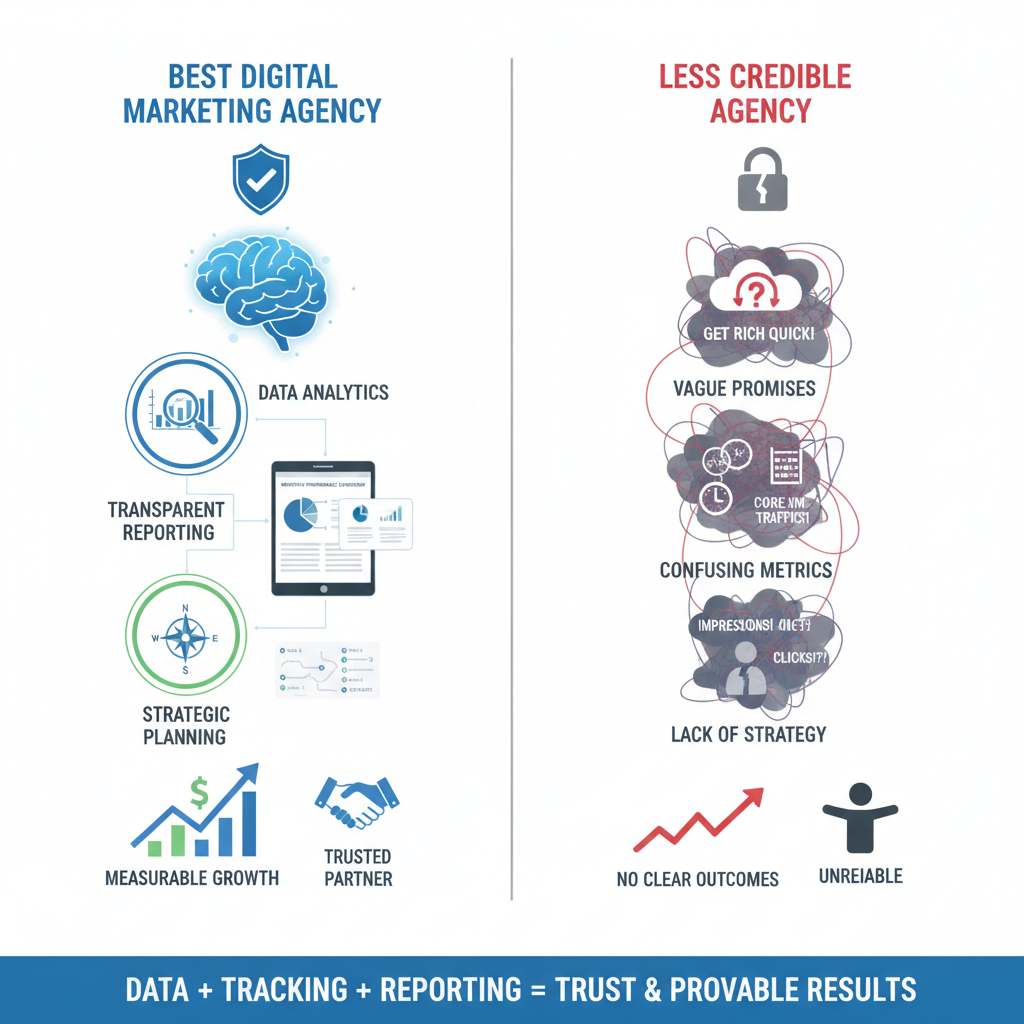
The best digital marketing agencies are not defined by presentation alone. They earn trust by showing how activity connects to measurable outcomes, and this broader guide on how best digital marketing agencies earn trust with data explains why clear tracking, plain-language reporting, and connected strategy matter when comparing providers.
In telehealth, this matters even more because the patient journey can include search research, symptom or service education, insurance or payment questions, booking friction, privacy concerns, and follow-up workflows. A credible agency should understand how SEO, paid search, landing pages, content, analytics, and conversion improvement work together instead of treating each channel as a disconnected campaign.
Why telehealth marketing needs a connected strategy
Telehealth audiences often arrive with specific intent. Some are searching for virtual appointments, online therapy, remote care options, medication support, chronic care management, or specialist access. Others may be comparing providers, checking availability, or trying to understand whether a service fits their needs.
A strong agency should map this journey before recommending tactics. Search engine optimization can help a telehealth website appear for relevant informational and service-related queries. Paid search can test demand faster and reveal which keywords, locations, messages, and landing pages produce stronger enquiry signals. Website and landing page work can reduce friction once visitors arrive.
If a telehealth provider is comparing agency capabilities, it can be useful to review how a full marketing system is structured. Zigma Internet Marketing outlines its approach through Digital Marketing Services, including SEO, paid ads, web work, content, social campaigns, and reporting.
What the best digital marketing agencies should understand about virtual care
Marketing for telehealth is not the same as marketing a general consumer product. The audience may need reassurance, clarity, accessibility, and a simple route to care. The agency should be able to identify whether growth is limited by visibility, website experience, unclear service pages, poor tracking, weak calls to action, or low-quality traffic.
For example, an online clinic might receive traffic but few bookings because the page does not clearly explain who the service is for, how appointments work, what information is needed, or what action to take next. A remote care company may have useful content but weak technical SEO, making it harder for search engines to understand the site structure. A virtual therapy provider may need better paid search segmentation so campaigns do not waste spend on irrelevant queries.
The agency’s role is to diagnose the issue before selling a fixed package. Good telehealth marketing depends on alignment between audience intent, service pages, technical performance, tracking accuracy, and follow-up processes.
SEO and paid search for telehealth providers
SEO and PPC can both support telehealth growth, but they serve different purposes. SEO helps build long-term visibility through technical health, content quality, internal linking, structured service pages, and search intent alignment. PPC can create faster learning by sending controlled traffic to specific landing pages and measuring which terms and messages lead to useful actions.
For telehealth providers, SEO may be especially valuable when patients or healthcare buyers research symptoms, services, provider options, or care models before making contact. Paid search may be useful when demand already exists and the organization needs faster data about search behaviour, service interest, geographic targeting, and conversion performance.
When evaluating an agency, compare how it approaches SEO Services and Google Ads Management. The right mix depends on website condition, competition, service category, urgency, and the quality of tracking already in place.
Landing pages and patient conversion paths matter
Even strong traffic can underperform if the landing page creates uncertainty. Telehealth pages should make the next step easy to understand. Visitors may want to know what the service includes, who provides care, how appointments are scheduled, whether the visit is virtual, what forms are required, and how follow-up happens.
The best digital marketing agencies review page experience as part of campaign performance. They should look at page speed, mobile usability, form clarity, button placement, trust signals, content structure, and analytics events. A paid campaign may be targeting the right audience, but if the page is slow or the booking path is unclear, the data may point to a conversion problem rather than a traffic problem.
If a telehealth website needs structural improvement before campaigns scale, Website Design & Development can become part of the marketing plan instead of being treated as a separate visual redesign project.
Signals of a credible agency for telehealth marketing
Telehealth organizations should evaluate agencies by process, not only by pitch quality. A strong agency asks detailed questions before recommending a channel. It should want to understand the care model, service areas, booking process, lead handling, website limitations, existing data, compliance considerations, and internal capacity.
Useful signals include:
- Clear diagnosis before tactics: The agency should explain whether the main issue is traffic quality, technical SEO, landing page performance, conversion tracking, content gaps, or lead follow-up.
- Channel recommendations based on intent: SEO, PPC, content, social campaigns, and web updates should be selected because they match the telehealth provider’s goals, not because they are part of a standard bundle.
- Tracking discipline: The agency should review forms, calls, booking actions, ecommerce events where relevant, ad conversions, and analytics setup before judging performance.
- Plain-language reporting: Reports should explain what changed, what the data suggests, and what action comes next.
- Awareness of patient journey friction: The agency should consider how visitors move from search query to service page to booking or enquiry.
Questions telehealth companies should ask before hiring an agency
A practical evaluation process helps reduce guesswork. Before comparing proposals, define what success means. A telehealth organization may need more appointment bookings, better-qualified enquiries, lower wasted ad spend, stronger organic visibility, improved call quality, demo requests, provider referrals, or clearer reporting.
Ask prospective agencies questions such as:
- How will tracking be audited before performance is judged? Poor measurement can make effective campaigns look weak or make weak campaigns look better than they are.
- Which actions will be treated as conversions? For telehealth, this may include form submissions, calls, booking clicks, account signups, consultation requests, or other meaningful actions.
- How will landing pages be reviewed? The answer should include copy clarity, mobile experience, page speed, form friction, calls to action, and trust-building elements.
- How will lead quality be evaluated? The agency should ask how enquiries are handled, how quickly follow-up happens, and whether internal feedback can be shared.
- What happens during the first 30, 60, and 90 days? A realistic plan often includes auditing, tracking cleanup, early campaign adjustments, content planning, technical fixes, and reporting setup.
- How will priorities change if the data contradicts the original plan? Strong agencies adapt based on evidence and explain why priorities shift.
Reporting should connect marketing activity to care access signals
Marketing reports should not stop at impressions, clicks, and rankings. Those numbers can be useful, but they do not answer the most important question: did the marketing activity help the right audience take the right next step?
For telehealth providers, reporting may need to show organic sessions, ranking movement, paid search terms, conversion rate, cost per lead, landing page performance, form submissions, call activity, booking actions, content performance, and technical issues resolved. The report should also explain what the agency changed and what it plans to do next.
Clean analytics setup is essential. Without reliable tracking in GA4, Google Tag Manager, ad platforms, phone tracking, form tracking, and booking-related events where relevant, decision-making becomes less reliable. The better question is not simply whether traffic increased. The better question is whether the right visitors took meaningful actions.
Common mistakes when comparing agencies
Telehealth organizations can make agency selection harder by comparing surface-level details instead of the operating process behind the work. A polished proposal, long service list, or confident sales call does not prove that an agency can diagnose the right growth problem.
Common mistakes include:
- Comparing deliverables without comparing strategy: Two agencies may both offer content, but one may build around search intent, service structure, and conversion paths while another simply publishes pages.
- Ignoring implementation capacity: Recommendations do not improve results unless tracking updates, website fixes, campaign changes, and content publishing actually happen.
- Judging SEO too quickly: Technical updates, content improvements, crawling, indexing, and authority signals can take time to influence visibility.
- Accepting reports without interpretation: A useful report should explain what the data means and what decision it supports.
- Separating marketing from operational feedback: Lead quality, response time, booking completion, and patient fit can help refine campaigns beyond platform metrics.
How content supports telehealth marketing
Content is often the bridge between visibility and trust. Telehealth audiences may need education before they are ready to book or enquire. Service pages, FAQs, condition-related resources, appointment guides, and comparison content can help visitors understand whether a virtual care option is appropriate for their situation.
Content should not be created only for keywords. It should also support patient decision-making, internal linking, paid campaign relevance, sales or intake conversations, and follow-up communication. The best digital marketing agencies connect content planning to search demand, website architecture, conversion paths, and reporting.
For telehealth organizations with multiple services, content structure becomes especially important. Pages should help users and search engines understand the relationship between services, locations, care types, providers, and appointment options.
FAQs about the best digital marketing agencies for telehealth
How can a telehealth provider tell whether a digital marketing agency is credible?
A credible agency asks detailed questions before recommending services. It should review tracking, website quality, patient journey friction, previous campaigns, lead handling, and reporting needs. It should also explain its strategy in plain language.
Should a telehealth company use SEO, PPC, or both?
Both can be useful, depending on goals and timing. SEO supports long-term visibility and educational content, while PPC can test demand, keywords, messages, and landing pages faster. The best choice depends on budget, competition, website condition, and tracking readiness.
What should an agency report each month?
Monthly reports should connect activity to decisions. Useful reporting may include qualified leads, conversion rate, traffic quality, keyword movement, campaign changes, spend efficiency, landing page performance, technical fixes, and next actions.
Why is tracking so important for telehealth marketing?
Tracking shows whether visitors are taking meaningful actions such as submitting forms, calling, booking appointments, or requesting information. Without clean tracking, it is difficult to know whether a campaign is attracting the right audience.
Should one agency manage SEO, PPC, and website work?
One agency can manage these areas if it has the right expertise and clear reporting. The advantage is better coordination between search data, landing pages, content priorities, technical fixes, and conversion tracking.
A practical way to choose a digital marketing agency for telehealth
The best digital marketing agencies make complex work easier to understand. They define the problem, map the channel mix, clean up measurement, execute the work, and explain the next decision. For telehealth providers, that process should connect visibility, patient experience, booking pathways, and reporting.
A strong agency relationship should feel organized rather than mysterious. If an agency can explain what is being measured, why it matters, and how each channel supports the patient or buyer journey, it is easier to judge whether the partnership fits.
If you want a second opinion on SEO, PPC, tracking, or landing page setup, you can ask an SEO/PPC question and share the context behind your marketing goals.