
Marketing Firms Near Me for Telehealth Providers: How to Choose Without Guesswork
Searching for marketing firms near me has a different meaning when you run a telehealth clinic, virtual care platform, remote patient monitoring service, or healthcare practice with online appointments. You are not only looking for more clicks. You need a marketing partner that can help patients find the right services, understand their options, book confidently, and move through a digital care journey without confusion.
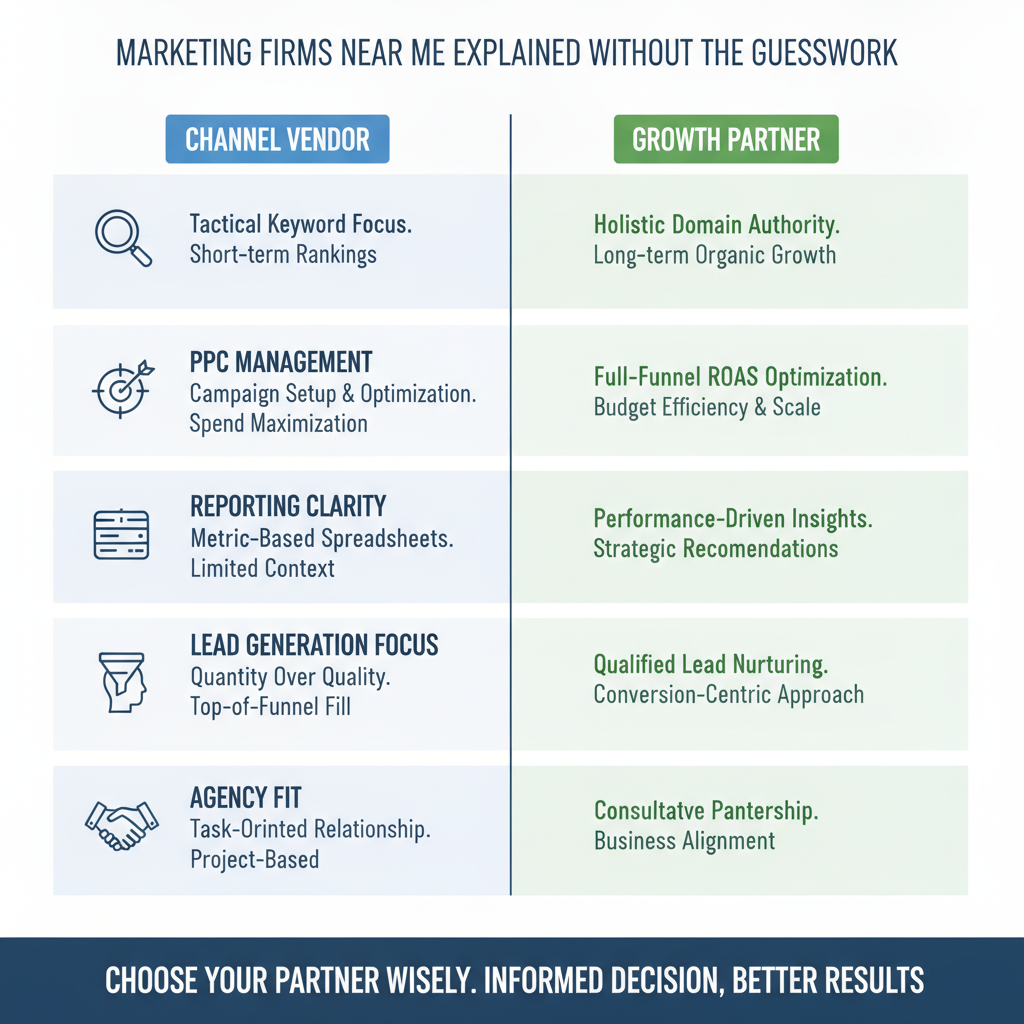
The original guide, Marketing Firms Near Me Explained Without the Guesswork, makes a key point that matters even more in telehealth: visibility and business results are not the same thing. A firm may be able to generate impressions, traffic, or ad clicks, but healthcare organizations need those efforts connected to appointment requests, qualified enquiries, patient education, and clear reporting.
For telehealth brands, the right firm should understand both digital growth and the sensitivity of health-related decision-making. That often means combining SEO Services, paid search, landing page improvements, local visibility, content planning, and analytics in a way that supports trust rather than hype.
What “marketing firms near me” means in a telehealth context
Most healthcare leaders are not simply trying to find the closest agency office. They are usually trying to find a team that understands their market, their patients, their referral pathways, and the way people search for care online. For a telehealth provider, that may include local patients looking for virtual appointments, caregivers researching services, employers comparing health solutions, or patients searching for a condition-related service.
A capable marketing firm may support search engine optimization, pay per click advertising, website updates, content strategy, technical SEO, landing page optimization, call tracking, form tracking, and reporting. The important part is not the service list alone. It is whether those services work together to help people move from search intent to a meaningful next step, such as booking a consultation, requesting information, or contacting the clinic.
This is where many telehealth organizations should be cautious. More website traffic does not automatically mean more appointments. A campaign that brings in broad informational visitors may not help if the landing page is unclear, the booking path is difficult, or the message does not match what the patient expected. Reviewing a provider’s broader Digital Marketing Services can help you see whether the firm is thinking beyond isolated tactics.
Why telehealth marketing requires more than generic lead generation
Telehealth marketing sits at the intersection of healthcare communication, local search, patient trust, digital access, and measurable growth. A general lead generation campaign may focus on volume, but a healthcare organization also has to consider service accuracy, patient privacy expectations, accessibility, and responsible messaging.
For example, a virtual physiotherapy clinic, online mental health practice, dermatology teleconsultation service, and chronic care platform may all need different campaign structures. Their keywords, landing pages, content tone, booking process, and follow-up model may differ significantly. A strong firm should ask about those differences before recommending a channel mix.
If you are comparing a digital marketing agency Toronto, a ppc agency Toronto, an seo company Toronto, or a broader marketing agency GTA, proximity can help with collaboration. However, the more important question is whether the firm can understand your patient journey and connect marketing activity to real outcomes.
What strong marketing firms do for telehealth organizations
Step 1: Clarify patient intent before choosing channels
People searching for virtual healthcare services may be at very different stages. Some are ready to book. Others are comparing providers, checking availability, learning about a condition, or trying to understand whether online care is appropriate for their needs. A strong marketing firm should map those search intents before deciding whether SEO, paid search, content, or landing page work should come first.
Watch for: Campaigns that send every visitor to the homepage, use generic health keywords, or ignore the difference between research searches and appointment-ready searches.
Why it matters: Matching intent to the right page helps reduce confusion and improves the quality of enquiries.
Step 2: Build trustworthy tracking before scaling spend
Telehealth organizations need to understand which channels are producing useful enquiries, not just traffic. A marketing firm should review whether forms, booking clicks, phone calls, and key page actions are tracked properly through appropriate analytics and tag management tools.
Watch for: Reports that focus only on clicks, impressions, or rankings without showing how those actions connect to appointment requests or patient enquiries.
Why it matters: Cleaner tracking helps teams make better decisions about budget, content, and campaign structure.
Step 3: Improve service pages before expanding campaigns
Many telehealth campaigns underperform because the service pages are too vague. A page should explain who the service is for, how the virtual appointment works, what the next step is, and why the provider is credible. It should also avoid making unclear or unsupported promises.
Watch for: Pages with weak headlines, unclear calls to action, too many competing buttons, or content that does not answer practical patient questions.
Why it matters: Better pages can increase the value of existing traffic before more money is spent on ads or content production.
Step 4: Strengthen local and service-area visibility
Even when care is delivered virtually, patients often search locally. They may look for providers licensed in their region, clinics near them, or services available in a specific city. Local SEO, Google Business Profile optimization, review management, and location-specific pages can all matter for telehealth providers with defined service areas.
Watch for: No plan for local search, inconsistent business details, weak location pages, or service descriptions that do not reflect how patients actually search.
Why it matters: Local search visibility can help virtual care providers appear where patients are already comparing options.
Step 5: Create a steady improvement cycle
Digital healthcare marketing should not rely on one-time setup. A useful agency reviews search terms, ad performance, landing page behaviour, technical issues, content gaps, and conversion data on a regular basis. The goal is to make measured improvements rather than random changes.
Watch for: Monthly reports that list activities but do not explain what changed, what was learned, or what should happen next.
Why it matters: Telehealth growth often improves through consistent refinement across search, ads, content, pages, and follow-up processes.
How to compare marketing firms near you
The simplest way to compare firms is to look at four areas: capability, clarity, accountability, and fit. Capability means the firm can handle the work you need, such as SEO services Toronto, paid search, landing page updates, technical SEO, content, or analytics. Clarity means the team can explain its plan in plain language. Accountability means reporting is connected to appointments, calls, forms, or other meaningful actions. Fit means the firm’s communication style works for your clinical, administrative, or executive team.
Telehealth providers should also compare specialist depth against full-funnel coordination. A narrow specialist may be useful if you only need one channel fixed. A broader agency may be more practical if SEO, Google Ads, web design, content, and conversion tracking all need to work together.
Helpful screening questions
- How do you define success? The answer should include business outcomes, not only traffic or rankings.
- What would you review first? Strong answers usually include tracking, search intent, page quality, campaign structure, technical health, and competitor positioning.
- How do you handle health-related content? The firm should understand that healthcare messaging requires accuracy, care, and review by appropriate internal stakeholders.
- Who performs the work? Strategy, implementation, and reporting quality can vary depending on who is actually managing the account.
- What would you avoid doing too early? A disciplined firm will not recommend every channel at once without diagnosis.
SEO for telehealth providers: building durable patient visibility
SEO can be especially valuable for telehealth organizations because many patients begin with search. They may look for symptoms, services, providers, virtual appointment options, or care available in a specific region. SEO helps your site become easier to find when those searches are relevant to your services.
For telehealth, SEO may include technical improvements, service page optimization, local SEO, content planning, internal linking, mobile usability, and Google Business Profile optimization where appropriate. It may also involve improving pages that explain how virtual care works, who is eligible, what patients can expect, and how to book.
The key is to avoid treating SEO as only a ranking exercise. Better rankings are useful, but the page still needs to answer the searcher’s question and guide them to the right next step. In healthcare, that guidance should be clear, accurate, and easy to navigate.
PPC and Google Ads for faster demand capture
Paid search can help telehealth organizations reach people who are actively looking for care options now. Compared with SEO, PPC can move faster and provide more control over targeted keywords, locations, ad messaging, and landing pages.
If your organization needs near-term visibility, Google Ads Management may help test which services, locations, and search terms are producing useful enquiries. Paid campaigns can also reveal which messages and pages perform best before investing more heavily in long-term content.
However, PPC should not be treated as a shortcut around weak pages or poor tracking. If ads are sending patients to unclear service pages, or if booking actions are not measured properly, the campaign may appear less effective than it really is. A strong Google Ads management Toronto partner should review both the ad account and the patient journey after the click.
Conversion optimization matters in virtual care
For telehealth providers, conversion optimization is about making the next step easier and clearer. Patients may hesitate if they do not understand how virtual care works, whether the service applies to them, what technology is required, or what happens after they submit a form.
A marketing firm with conversion rate optimization Toronto experience should review page structure, calls to action, booking flow, mobile usability, trust signals, form length, and message match between ads or search listings and landing pages. The goal is not to pressure patients. It is to reduce friction and help people find the right path.
Common conversion issues in telehealth marketing
- Unclear service descriptions: Patients cannot tell whether the service fits their need.
- Complicated booking paths: Too many steps can cause people to abandon the process.
- Weak mobile experience: Many healthcare searches happen on mobile devices.
- Missing trust cues: Patients may need clearer information about providers, process, credentials, or availability.
- Disconnected messaging: Ads, search snippets, and landing pages should describe the same service clearly.
How smaller telehealth providers can compete online
Smaller clinics and virtual care providers often assume they must outspend larger healthcare brands. In many cases, they need sharper positioning instead. A focused campaign around the right services, locations, and patient needs can be more useful than broad marketing activity spread across too many channels.
For example, improving two high-value service pages, cleaning up local search visibility, and tightening paid search targeting may be more practical than launching a large content campaign immediately. The same principle applies to website work. A focused update that improves speed, clarity, and booking flow may be more valuable than a visual redesign that ignores search intent.
Where smaller providers can gain ground
- Service-page depth: Detailed pages can answer practical patient questions better than broad overview pages.
- Local relevance: Location and service-area signals can help patients understand whether care is available to them.
- Clear booking steps: Simple forms and direct calls to action can improve enquiry quality.
- Content accuracy: Health-related content should be useful, responsible, and reviewed appropriately.
- Measurement discipline: Leads, appointment requests, and enquiry quality matter more than isolated vanity metrics.
Questions to ask before hiring a marketing firm
Before choosing among marketing firms near you, ask for process clarity rather than broad promises. Who owns strategy? How are patient enquiries tracked? What happens in the first 30 days? Which pages need improvement? Which services are likely to perform first? How often will campaigns be reviewed?
It is also important to understand implementation. Some firms provide recommendations but expect your internal team to make all website, content, and tracking updates. Others manage more of the execution, including SEO, ads, landing pages, reporting, and technical changes. If your healthcare team has limited internal marketing capacity, that difference can affect speed and consistency.
For organizations that need coordinated support across SEO, PPC, content, web updates, and measurement, Zigma Internet Marketing offers a practical approach to digital growth. The team is based in Markham and serves Toronto and the GTA, supporting businesses that need clearer visibility into what is driving calls, forms, and sales. If you need guidance, ask an SEO/PPC question.
FAQs About Marketing Firms Near Me for Telehealth
Does a telehealth provider need a local marketing firm?
Not always. Proximity can help with communication, but the more important factors are healthcare marketing understanding, reporting quality, technical capability, and the ability to connect campaigns to patient enquiries or bookings.
Should telehealth providers start with SEO or PPC?
It depends on timing. SEO is useful for building long-term visibility, while PPC can help capture demand faster and test service messaging. Many providers benefit from using both, especially when paid search insights inform SEO and landing page improvements.
What should a marketing firm review first?
A strong first review should include analytics, conversion tracking, search intent, website structure, service pages, local visibility, ad accounts if applicable, and the booking or enquiry process.
How can telehealth providers judge reporting quality?
Useful reports should explain what changed, why it changed, and how those changes affected meaningful actions such as appointment requests, calls, forms, or qualified enquiries. Reports focused only on clicks and impressions are incomplete.
What makes healthcare marketing different from general marketing?
Healthcare marketing requires extra care around accuracy, trust, patient expectations, service clarity, and review processes. Campaigns should be designed to inform and guide patients responsibly, not simply maximize traffic volume.
A clearer way to choose marketing firms near me
The best marketing firm for a telehealth organization is usually not the one with the loudest pitch. It is the team that can diagnose the real bottleneck, explain the plan clearly, measure the right actions, and improve the patient journey from search to booking. For some providers, that starts with SEO. For others, it starts with paid search, landing page updates, local visibility, or better tracking. The right choice begins with clear diagnosis, then steady execution.